Whale Watching at Sunset on Maui: December Through April
For five months of the year the same stretch of channel serves two purposes at once. The boats know it, the whales do not, and only one sailing on the island is built around both.
Short answer
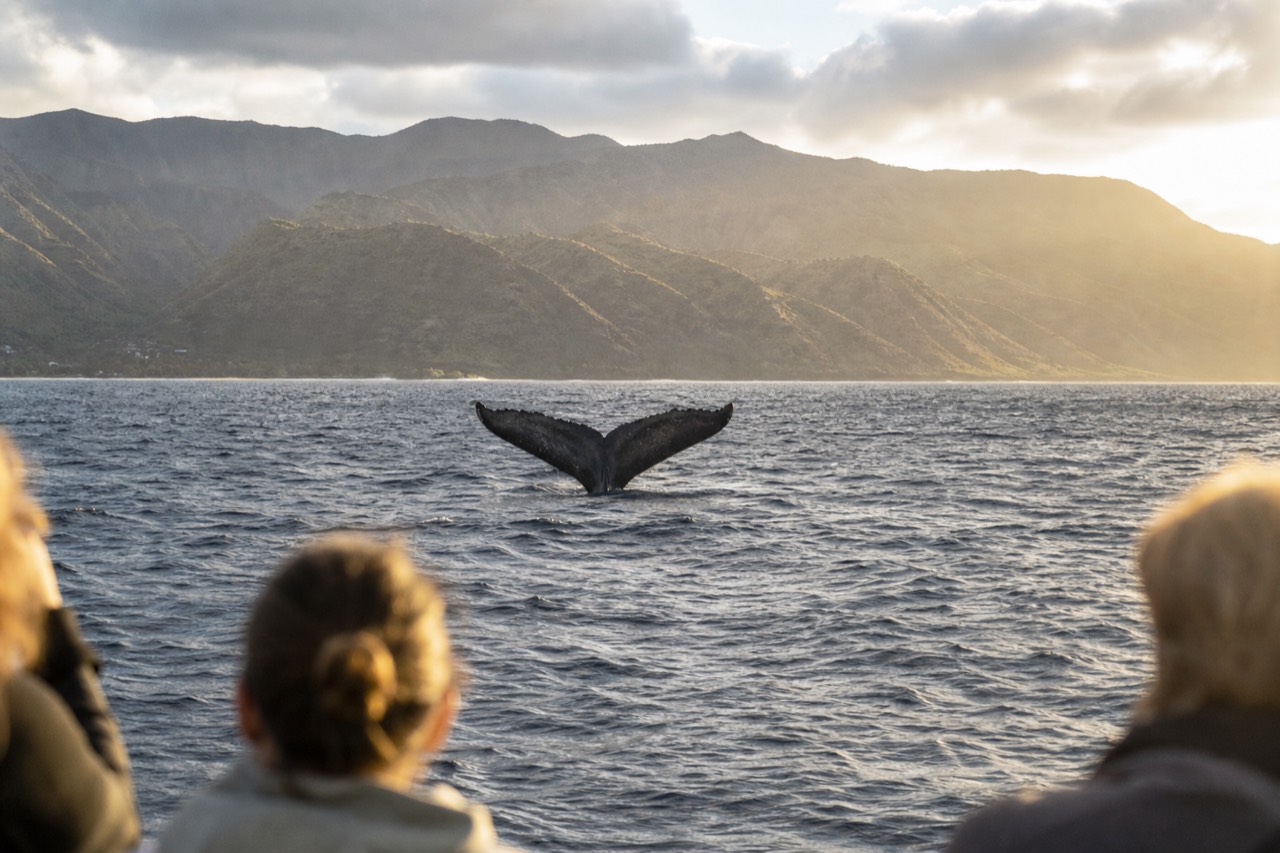
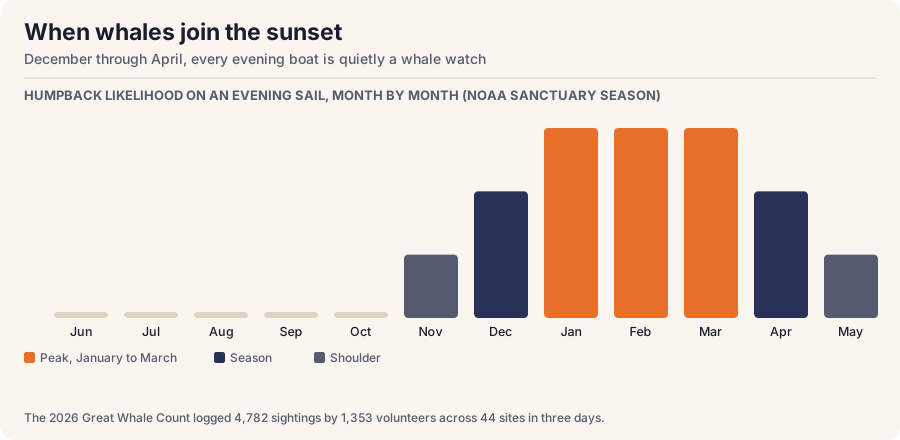
Humpbacks are in Hawaiian waters from November through May, with peak numbers from January through March. One Maalaea sailing pairs a sunset dinner with a whale watch, running December to April at $189 for three hours, rated 4.7 across 516 reviews. Regular sunset sails in the same water see whales too, without promising them.
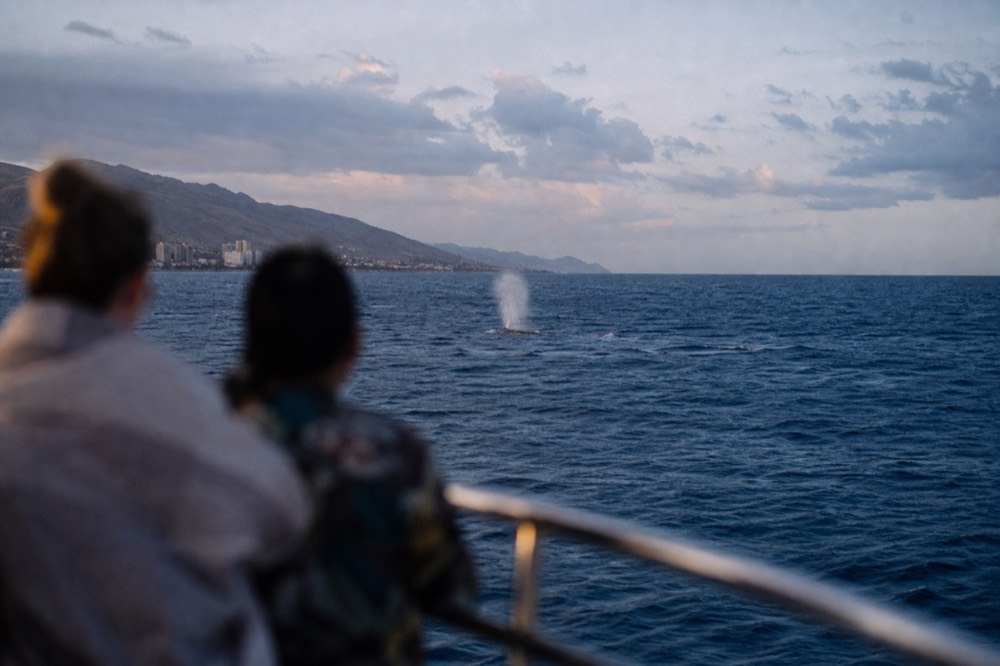
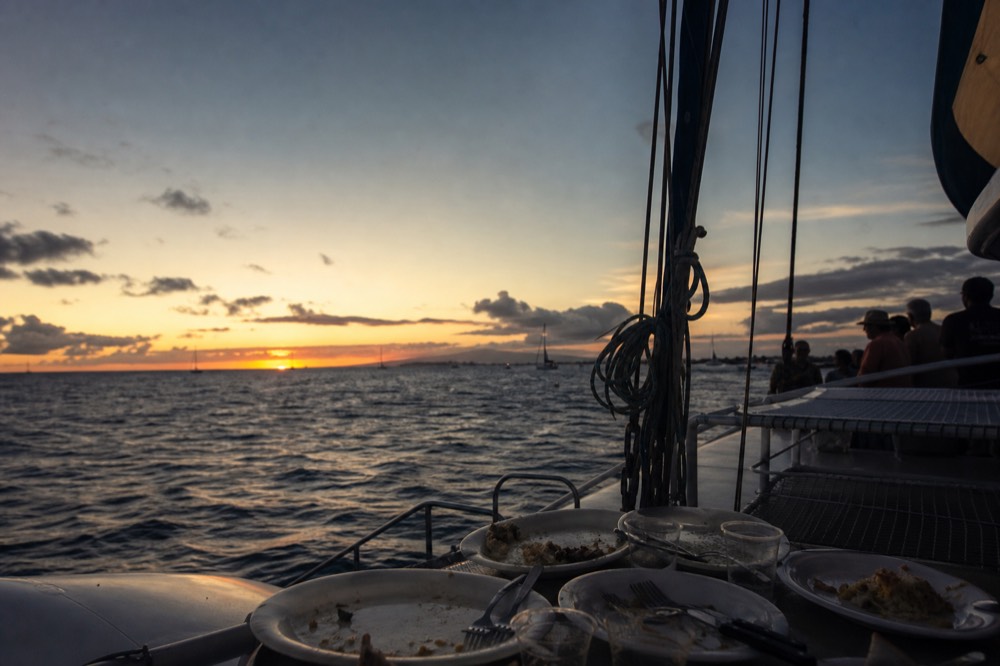
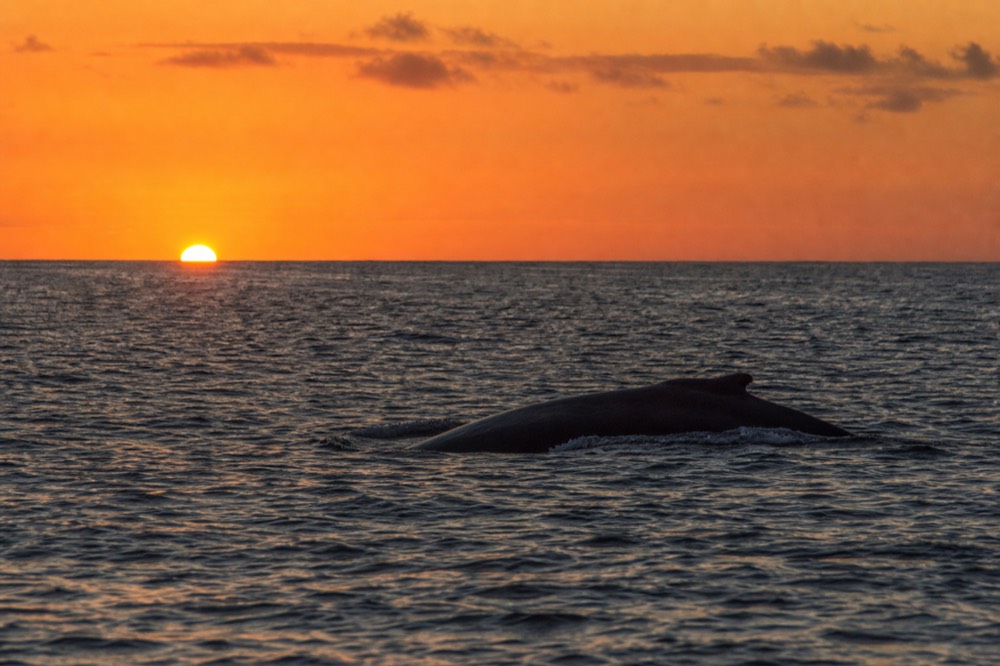
A blow at half a mile looks like nothing much: a puff of white that holds for a second or two against gray water, then goes. On a February evening in the Auau Channel you might see six of them in an hour without any boat changing course, because the animals are simply there, spread across the water between Maui and Lanai, doing what they came the whole way from Alaska to do. The sunset happens on top of that, unrelated and unbothered.
That overlap is the whole subject of this page. From roughly December through April, an evening sailing on Maui is two things at once for the price of one, and exactly one product on the island is designed around that fact rather than benefiting from it by accident. Knowing which is which, and when, is the difference between a good booking and an expensive disappointment in July.
When can you actually see humpbacks on an evening sailing?
Humpback season in Hawaiian waters runs November through May, with peak abundance from January through March. The one sunset product built around whales operates December to April. Outside that window, from June through October, there is nothing to plan around, and no honest operator will suggest otherwise.
The rhythm is consistent year to year. North Pacific humpbacks arrive from Alaskan feeding grounds through late autumn, numbers build through December, hold high through the first three months of the calendar year, then thin out through spring as animals head north again. NOAA's sanctuary guidance sets the season as November through May and the peak as January through March, which is the framing worth planning around.
Early arrivals do happen. The first sightings of the 2025 to 2026 season were reported off Maui as early as September 2025, which makes for good local news and terrible trip planning. One or two animals in the channel in September is not a whale season. It is a curiosity, and no boat will build a product on it.
The practical consequence is that the calendar decides this, not the boat. Book a February evening and whales are close to a background condition of being on the water. Book a July evening and you are booking a sunset, full stop, which is a fine thing to book and a completely different expectation. Whether a sunset sailing counts as whale watching goes into that distinction in more depth.
| Month | Humpback likelihood | Sunset on the 15th | What an evening sailing feels like |
|---|---|---|---|
| January | Peak | 6:07pm | Whales likely in view, short daylight window before the sun goes |
| February | Peak | 6:25pm | Highest counts of the season, cool evenings, layers needed |
| March | Peak | 6:36pm | Still peak, more daylight, mothers and calves about |
| April | Season winding down | 6:46pm | Numbers falling, sightings still common early in the month |
| May | Tail of the season | 6:57pm | Occasional animals, not a reason to book |
| June | None expected | 7:09pm | Longest evenings of the year, latest sunsets |
| July | None expected | 7:11pm | Latest sunset of the year, 7:12pm in early July |
| August | None expected | 6:56pm | Warm, settled, sunset only |
| September | Isolated early arrivals possible | 6:29pm | Not something to plan around |
| October | Isolated early arrivals possible | 6:02pm | Season has not started in earnest |
| November | Season opens, numbers building | 5:46pm | Earliest sunsets of the year, 5:44pm in late November |
| December | Building toward peak | 5:48pm | Dedicated whale dinner sailing starts running |
Sunset figures come from United States Naval Observatory sun data for Lahaina, and they move by more than an hour and a half across the year. Hawaii does not observe daylight saving, so the shift is purely astronomical. Sunset times month by month sets out the full year against typical boarding windows.
What does a dedicated dinner and whale watch add?
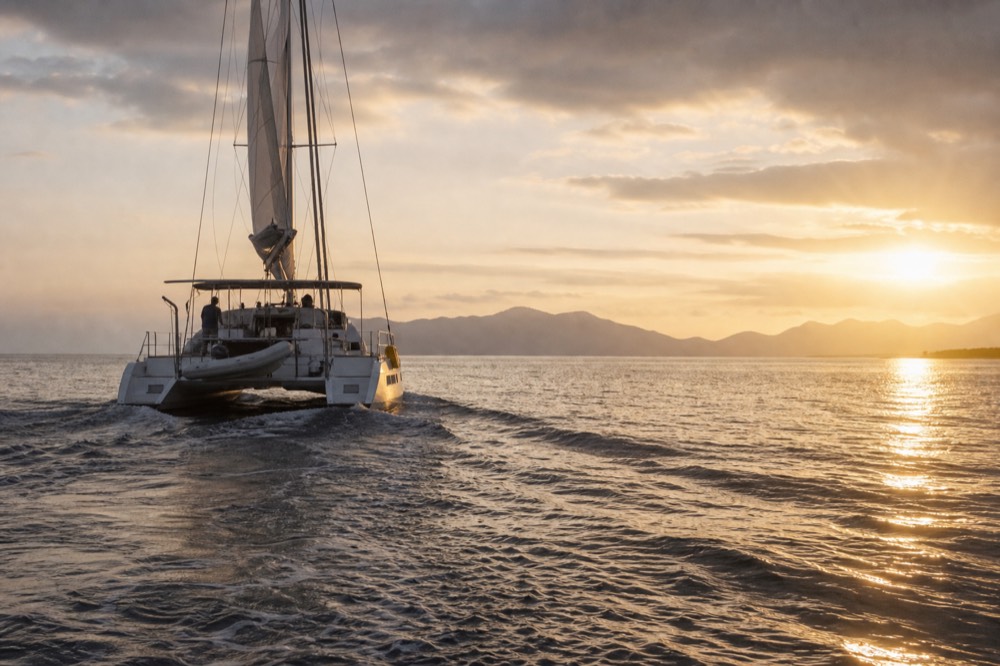
A third hour, a route built around whale water, and a crew whose job includes spotting. The Maalaea sunset dinner and whale watch runs three hours at $189 against two hours for most dinner boats, rates 4.7 across 516 reviews, and operates only from December through April. Regular sailings see whales without organizing around them.
The difference is intent, and it shows up in three places. Time is the obvious one: three hours instead of two gives the boat room to work an area rather than head for a sunset position and hold there. Route is the second: a whale-watch product goes where the animals are known to be, which is not always where the light will be best. Personnel is the third, and it matters more than people expect, because spotting is a learned skill and a crew doing it deliberately finds far more than a deck of passengers scanning at random.
The operator behind that sailing is a nonprofit whose work centers on whales, and 2026 marked its 45th anniversary with World Whale Day events across the island. In February 2026 it announced a partnership with Norwegian Cruise Line Holdings to expand keiki whale watch programs, roughly doubling access for Maui students. That is context rather than a reason to book, but it does tell you what the organization is for.
Against that, a $189 fare for three hours sits above the mid-range dinner boats at $140 to $180 and below the luxury end at $290. Set against the $168 to $180 tier it most resembles, you are paying $9 to $21 more and getting an extra hour plus a purpose. In peak season that is straightforward value. In late April, with numbers falling, the arithmetic is less obvious.
| Dinner and whale watch | A regular sunset dinner cruise | A cocktail sail in whale season | |
|---|---|---|---|
| From price | $189 | $140 to $180 | $102 to $137 |
| Length | 3 hours | 2 to 2.5 hours | 2 to 2.5 hours |
| Season | December to April only | Year round | Year round |
| Route | Built around whale water | Built around the sunset position | Built around the sunset position |
| Spotting | Part of the job | Incidental | Incidental |
| Rating | 4.7 across 516 reviews | 4.5 to 4.8 | 4.7 to 4.8 |
| Best for | Peak season, whales as the point | Any month, dinner as the point | Any month, drinks and sky as the point |
It sells against a narrow five-month window, and peak weeks go early.
How close can a boat legally get to a humpback?
No closer than 100 yards, anywhere in Hawaiian waters, all year. The federal rule applies to every vessel, swimmer, kayak and drone, and it covers the full 200 nautical mile zone rather than just the sanctuary. Captains cut power and hold position when an animal surfaces nearby rather than repositioning to close the gap.
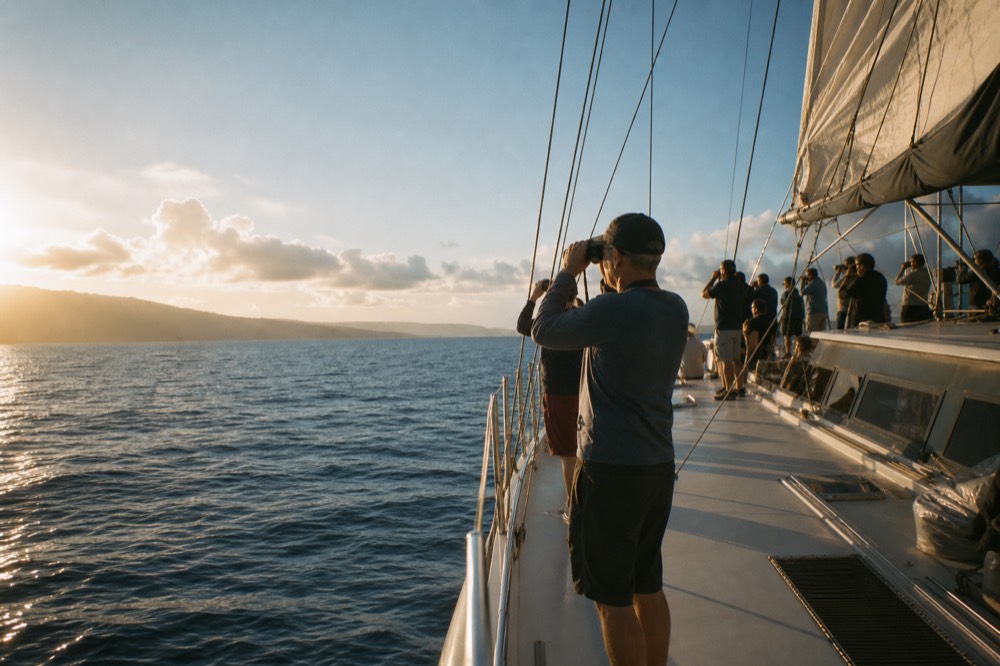
This is the single most useful fact for setting expectations, and almost nobody reads it before booking. One hundred yards is roughly the length of a football pitch. A humpback at that range is unmistakably a whale and unmistakably far away, which is why every honest description of Maui whale watching talks about blows, backs and flukes rather than eye contact.
The rule exists because the sanctuary water off Maui is a calving and nursing area, and the animals in it include newborn calves. NOAA sets out the approach rules for boaters in sanctuary waters and enforces them. Operators here take it seriously, partly from conviction and partly because their commercial permits depend on it.
What happens in practice is more interesting than the rule suggests. Boats hold their distance, but whales do not read the regulation, and animals surface near vessels often enough that most whale-season passengers get at least one close pass without anybody breaking anything. When that happens the crew stops the boat and everyone stands still. Those are the moments people describe afterwards.
Drones are worth flagging separately, because visitors bring them and assume the rule is about hulls. It is not. The 100-yard limit covers aerial approach as well, so a drone launched from a boat to get a better angle is the same violation as steering closer would be.
| The rule | What it means on the water |
|---|---|
| No approach within 100 yards of a humpback | Vessels hold off; the whale can close the gap, the boat cannot |
| Applies to vessels, swimmers, kayaks and drones | No launching a drone for a closer angle from the deck |
| Applies year round | Not a seasonal restriction, it stands in July as in February |
| Applies throughout Hawaiian waters | Not limited to marked sanctuary boundaries |
| Engines out of gear when an animal surfaces close | Boats stop and wait rather than reposition |
| No swimming with humpbacks | There is no legal in-water humpback experience here |
Which boats give you the best chance in whale season?
Anything working the Auau Channel between Maui and Lanai, which is the heart of the calving water. That includes the Lahaina sails at $102 and $117, the Kaanapali fleet, and the Maalaea boats that run toward Lanai. The dedicated dinner and whale watch at $189 is the only one that makes finding them its job.
Geography is doing the work again. The Auau Channel sits sheltered by four islands, which makes it the calmest coastal water in the state and, not coincidentally, the water humpback mothers favor with young calves. Boats out of Lahaina and Kaanapali are in it from the moment they leave. Boats out of Maalaea reach it by heading west, or work Maalaea Bay instead.
Vessel type matters less than most people assume, but it is not irrelevant. A sailing catamaran under sail is quiet, which is pleasant and occasionally productive. A larger dinner boat has more deck to move around on and better sightlines from an upper level. A six-guest powerboat has neither the height nor the crowd, and is the closest thing to a private viewing platform on the island at $251.
Sarah wrote in February 2026 about the 'Alihilani out of Lahaina: "The cruise and whale watching was amazing! The crew was lovely, open bar and snacks were great, and we saw a ton of whales." That sailing is not sold as a whale-watch product at all. It is a $117 sunset sail with drinks, rated 4.8 across 367 reviews, that happens to run through the right water at the right time of year.
| Boat type in whale season | From | Advantage | Trade-off |
|---|---|---|---|
| Dedicated dinner and whale watch, Maalaea | $189 | Three hours, route and crew built for spotting | December to April only, highest fare of the group |
| Lahaina sails | $102 to $117 | Straight into the Auau Channel from the dock | No dinner, two to two and a half hours |
| Kaanapali catamarans | $135 to $180 | Sheltered channel water, wide fleet choice | Wet-feet boarding, no whale focus |
| Maalaea dinner boats | $140 to $180 | Deck space and upper-level sightlines | Whales are incidental to the route |
| Six-guest powerboat, Maalaea | $251 | No crowd at the rail, fast repositioning | Small deck, exposed, priced for the privacy |
| Nonprofit sunset sail, Maalaea | $138 | Crew steeped in whale work, two hours | Not sold as a whale product |
How many whales are actually out there?
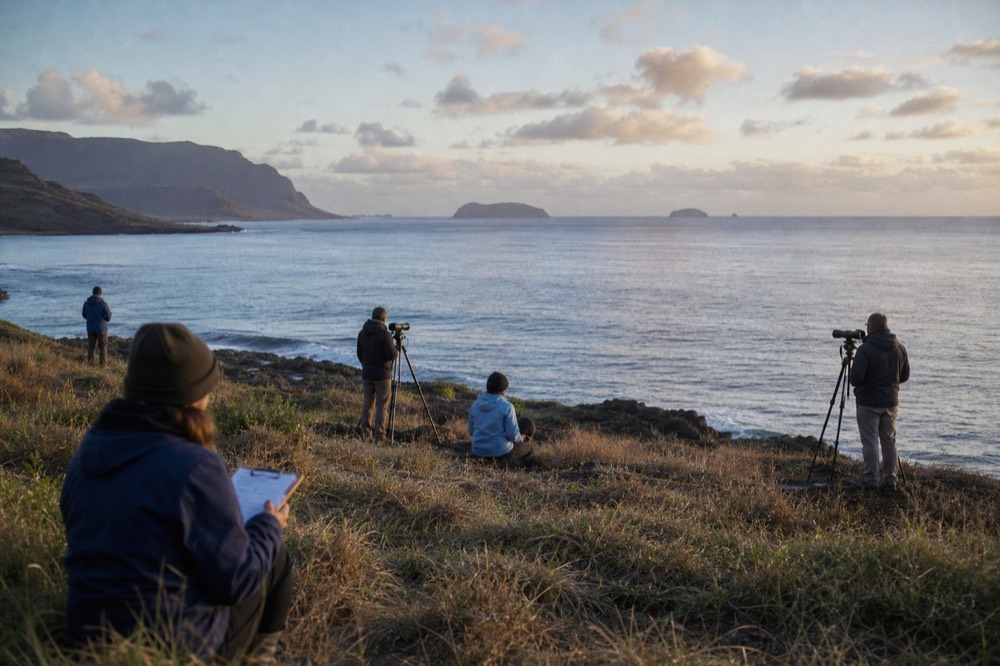
Enough that organized counts run into thousands. The 2026 Great Whale Count recorded 4,782 sightings across 44 sites over three days, with 1,353 volunteers taking part. A single February count day in 2026 logged 1,935 whales across the islands. Sighting totals can include the same animal more than once.
Shore-based counts are the closest thing to a population picture that visitors can read directly, and they are worth understanding properly. Volunteers stand at fixed sites around the islands, watch a defined patch of water for a defined period, and record what they see. The totals that come out are counts of sightings, which is not the same as counts of individual animals, because a whale moving along a coast can be logged by more than one site.
The shape of the season shows in the numbers more clearly than any description does. February 28, 2026 produced 1,935 whales across the islands from 487 volunteers at 46 sites. Four weeks later, on March 28, the final count of the season produced 435 whales from 37 sites. That is the tail of the season arriving, visible in a single month of data.
For anyone choosing between a January trip and an April one, that decline is the argument. Both months sit inside the operating window for the dedicated whale dinner. They do not offer the same water. The peak really is the peak, and the difference between mid-February and late April is not marginal.
None of which is a guarantee, and no operator on this island offers one. Whales are wild animals in open water, weather affects visibility, and a boat can work good water for three hours and see two blows. What the counts tell you is where the odds sit, which is the most anyone can honestly promise.
Does the timing work, whales and sunset in the same two hours?
In peak season, yes, because sunset falls between 6:07pm and 6:46pm from January through April, leaving usable spotting light for most of a sailing. In December the sun is down by 5:48pm, so an evening departure has a short bright window. Departure times sit on each listing and shift with the season.
Light is the constraint nobody plans for. Spotting a blow at distance needs contrast, and contrast collapses in the last half hour before sunset when the water turns to glare and then to shadow. The practical spotting window on an evening sailing is the stretch before the sun gets low, which in December is short and in April is generous.
That flips the usual logic about which month to visit. Late in the season, when whale numbers are falling, the light lasts longer and the sailing has more usable time in it. Early in the season, when numbers are climbing toward peak, the sun is at its earliest of the year, 5:44pm in late November. The best combination of both is the January to March window, where numbers are at maximum and sunset has moved back to between 6:07pm and 6:36pm.
Boarding sits roughly 30 to 45 minutes ahead of departure across the fleet, so a whale-season evening starts earlier than people plan for. Add the drive, which from Kihei to Maalaea is about 15 minutes and from Kaanapali about 40, and a February sailing can mean leaving your hotel in the middle of the afternoon. How the three harbors compare has the full drive-time picture.
| Whale-season month | Sunset on the 15th | Light quality for spotting | Notes |
|---|---|---|---|
| December | 5:48pm | Short bright window before the sun drops | Numbers still building; earliest sunsets of the year |
| January | 6:07pm | Good, sun still up for much of a sailing | Peak numbers begin |
| February | 6:25pm | Good, longer usable window than January | Highest counts of the season |
| March | 6:36pm | Best of the peak months for light | Still peak; calves visible |
| April | 6:46pm | Longest window of the whale-season group | Numbers falling through the month |
What will your photographs really look like?
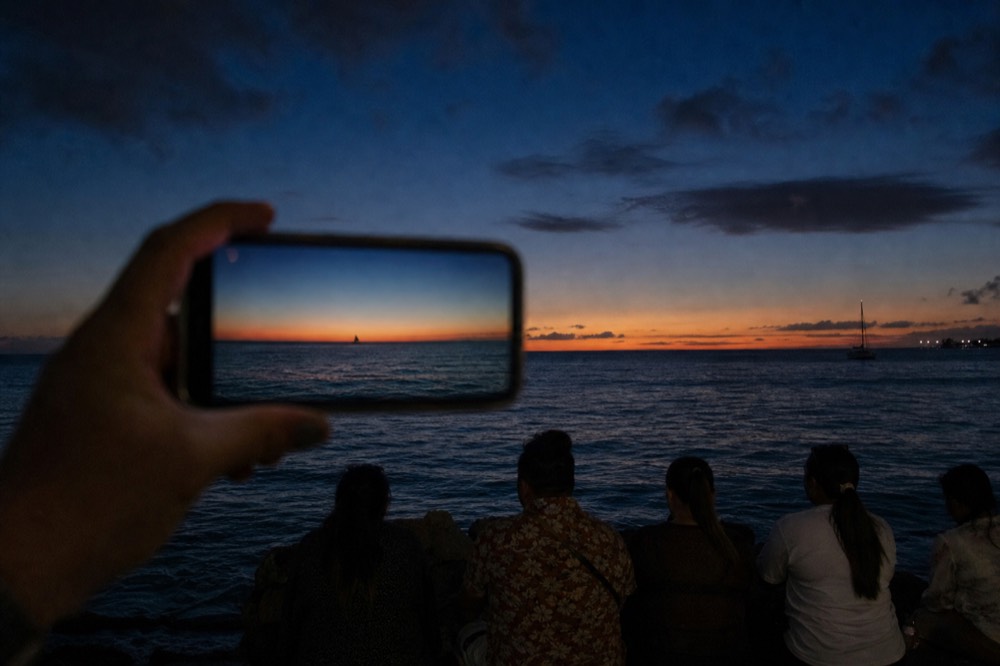
Distant. At 100 yards with a phone, a humpback fills a small fraction of the frame and reads as a dark shape and a splash. Blows and flukes photograph better than bodies. The pictures that work from these sailings are usually of the sky and the boat, with the whale as a detail people remember rather than an image.
This is worth saying plainly, because the gap between expectation and result causes more quiet disappointment than any other part of a whale-season sailing. Every marketing photograph of a Hawaiian humpback was taken with a long lens by somebody whose job it is, often from a permitted research platform. Your phone at the legal distance will not reproduce it, and no operator can change that.
What does photograph well is the moment rather than the animal. A fluke going down against an orange sky is a good picture at almost any distance, because it reads as a silhouette. A blow catching low sun is a good picture. Six people at a rail all looking the same way with the light behind them is a better picture than most whale shots anybody gets.
The practical advice is short. Put the phone down for the first sighting and look at it properly. Shoot video rather than stills if you want something to keep, because a moving dark shape reads as a whale where a still frame reads as a wave. And accept that the best record of the evening will be the sunset, which is what the boat was actually built to deliver.
| What you want | What you will realistically get | Better approach |
|---|---|---|
| A close-up breach | A distant splash, if you catch it at all | Video, wide, and watch with your eyes |
| Fluke against the sunset | Achievable, and the best shot of the evening | Pre-focus on the horizon, burst mode |
| A blow in low sun | Achievable and underrated | Watch for the puff, shoot immediately |
| Mother and calf detail | A pair of dark shapes at range | Binoculars beat any phone camera here |
| The evening as a whole | The sunset, the boat, the people | This is what the sailing is really for |
Which departure point puts you in the whale water fastest?
Lahaina, then Kaanapali. Both sit on the Auau Channel, so their boats are in calving water minutes after leaving. Maalaea boats reach the same water by heading west, or work Maalaea Bay, which also holds whales in season. The dedicated dinner and whale watch runs from Maalaea despite that extra distance.
The channel between Maui and Lanai is the centerpiece of the whole Hawaiian humpback story, sheltered by four islands and shallow enough to suit mothers with calves. West Maui departures start in it. That is a genuine advantage for a two-hour sail, where transit time is a big share of the total.
Maalaea's position is different and not worse. The bay itself carries whales through the season, the harbor is the largest on the island with thirteen bookable sunset sailings, and the extra hour on the dedicated whale product exists partly to cover the ground. Free parking at the harbor and dock loading also make it the easier departure for anyone travelling from the south side. The Maalaea fleet covers the whole set.
Wind is the counterweight. Trade winds funnel across the isthmus and make Maalaea the breeziest departure on Maui through the afternoon, easing toward sunset. The Auau Channel side stays sheltered, which is more comfortable for a long stretch at the rail with binoculars. In February, with cool air and a wet deck, that comfort gap matters.
Sailings out of Lahaina Harbor are the shortest route to whale water on the island, and both current options rate 4.8. The Kaanapali boats are close behind, with the trade-off being that you wade to them off the sand rather than walking down a dock.
What should you book if you are visiting outside whale season?
A sunset sailing, chosen on its own merits. From June through October there are no whales to plan around, so the decision becomes price, format and harbor. Fares start at $59.95 for a cocktail cruise and $71 for the island's highest-rated sail, and the latest sunsets of the year fall at 7:12pm in early July.
Summer visitors get a better version of a different thing. Sunsets are at their latest, the evenings are warm enough that a light jacket is optional rather than necessary, and the fleet is not competing for the same peak-season dates, which means better availability at shorter notice.
The choice then comes down to format rather than season. A two-hour sail with drinks at $71 to $137, a dinner cruise at $140 to $290, or a cocktail sail with an open bar somewhere between. Cocktail sails and open-bar boats and the full dinner lineup split the fleet along that line, and the ranked comparison of every boat puts all twenty in order.
One nonprofit-run option keeps a foot in both camps year round. Its regular sunset sail at $138 carries 4.6 across 221 reviews, runs two hours out of Maalaea, and is crewed by people who spend the winter months on whales. In July there are no whales to find, and the crew knowledge still shows.
Can you see whales on a Maui sunset sailing in December?
Yes. December sits inside humpback season, with numbers building toward the January to March peak, and the dedicated dinner and whale watch starts running that month. The catch is light: sunset falls around 5:48pm in mid-December, so the bright spotting window on an evening sailing is short.
Do sunset sails guarantee whale sightings?
No, and none should. Humpbacks are wild animals in open water, and even peak-season sailings can produce a quiet evening. What the season data supports is a strong likelihood between January and March, a fair one in December and April, and effectively none from June through August.
How close will the boat get to a whale?
No closer than 100 yards. That federal limit applies to every vessel, swimmer, kayak and drone throughout Hawaiian waters, all year. Whales sometimes close the distance themselves, at which point the crew takes the engines out of gear and waits rather than repositioning.
Is the dedicated whale dinner cruise worth the extra money?
In January, February and March, the case is strong: three hours instead of two, a route built around whale water, and a crew actively spotting, for $189 against $140 to $180 for a standard dinner cruise. In late April, with counts falling sharply, the margin narrows considerably.
When is the best month for whales and sunset together?
March, on balance. Numbers are still at peak levels, and sunset has moved out to around 6:36pm, giving a much longer usable spotting window than December or January. February produces the highest counts but a shorter evening.
Your evening, your choice
Choose your Maui evening
Initial editorial pick — use the optional filters to narrow it.
Compare options, fit and total cost
Why consider another option?
- Sea Maui sunset cocktail sail — Heavy appetizers and an open bar on a two-hour beach-loading sail. Kaanapali · 2 hours · English. Barefoot beach boarding; moderate fitness. Check in 30 minutes early. Alcohol 21+ with ID.
- Teralani sunset cocktail sail — Chef-inspired appetizers and an open bar on a two-hour catamaran sail. Kaanapali · 2 hours · English. Wade through the water and remove shoes to board. Not suitable for wheelchair users. Alcohol 21+; bring photo ID. Cancellation cutoff is two days ahead.
Compare the whole evening
Use current, same-currency totals for your group, including tax, food, drinks, parking and any planned tip.
A shared ticket total is not an exclusive-charter quote. Compare inclusions as well as the difference.