What Actually Happens on a Sunset Cruise in Maui
Nobody tells first-timers that the sunset is the middle of the evening, not the end of it. Boarding, the outbound leg and the dark run home take up more of the night than the sun does.
Short answer
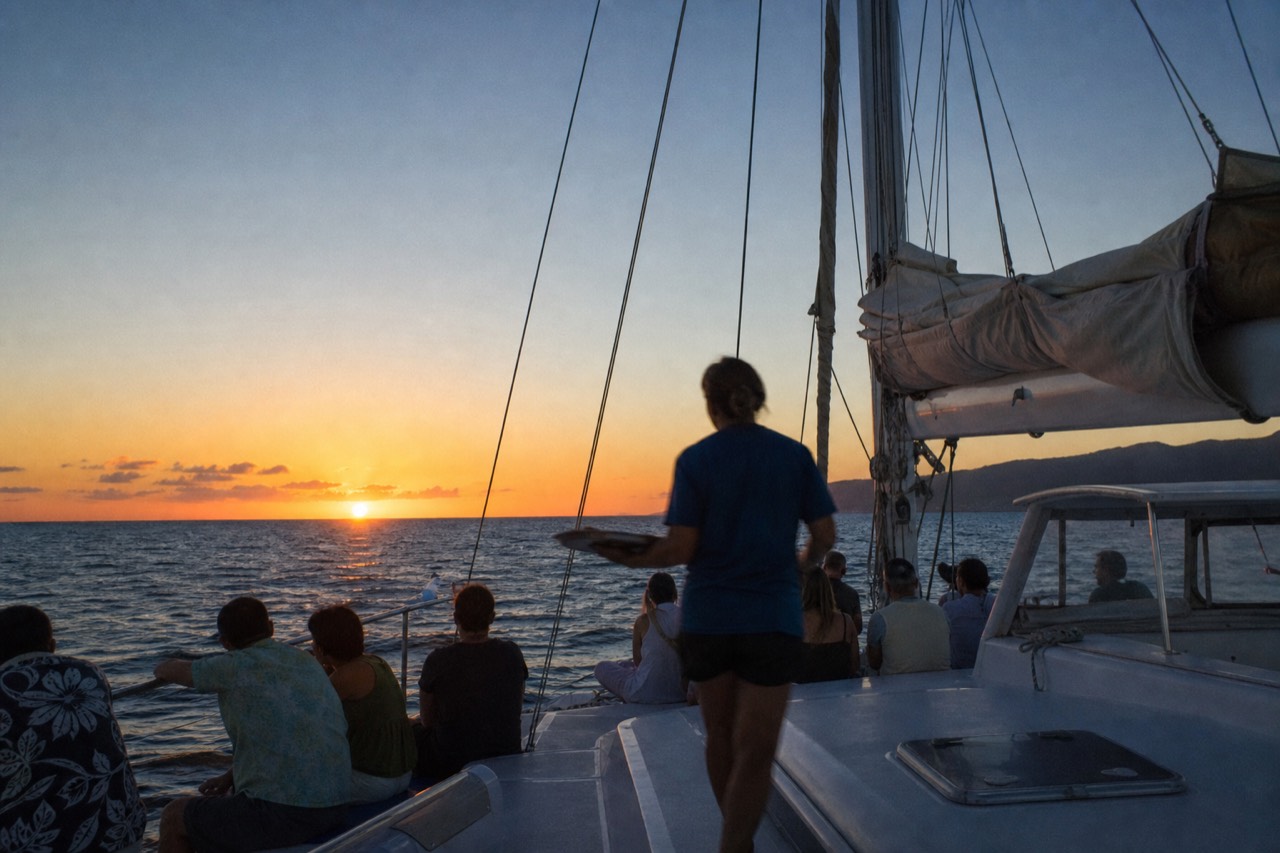
Check in 30 to 45 minutes before departure at a beach kiosk or a numbered slip. Kaanapali boats load off the sand in knee-deep water; Ma'alaea and Lahaina board from docks. The bar opens once the boat clears, food follows on the outbound leg, sunset lands mid-cruise, and you return in full dark.
The catamaran does not come to a dock. It runs its bows up onto Ka'anapali Beach, a crew member drops into the shallows, and sixty people carry their shoes into knee-deep water and get hauled up onto a step. That is how five of the twenty evening boats on Maui start, and almost nobody expects it the first time.
The rest of the evening has a shape too, and it is not the one the photographs suggest. Sunset is not the finale. On a two-hour sailing it lands roughly in the middle, with a full outbound leg before it and a dark run home after. Knowing where the pieces sit changes what you wear, when you eat, how much you drink in the first thirty minutes, and whether you spend the good light queueing at a buffet. Here is the whole thing in order.
What does the evening look like, start to finish?
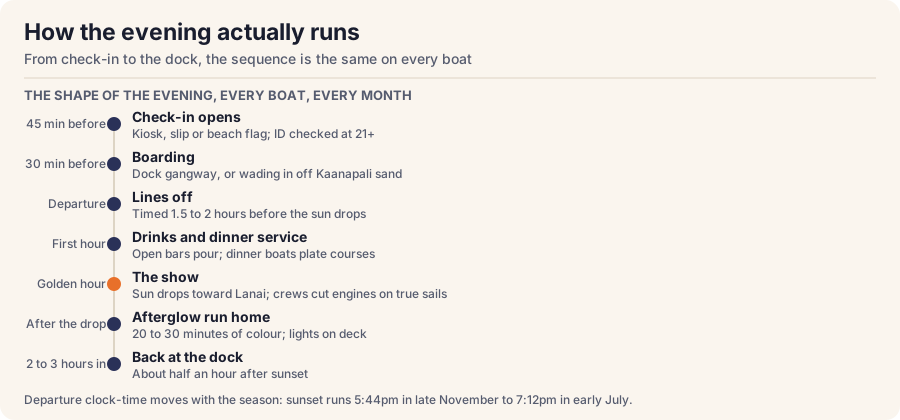
Check-in runs 30 to 45 minutes before departure. Boarding starts 15 to 20 minutes out. The bar opens once the boat clears the shore break or the harbor mouth. Sunset falls near the middle of a two-hour sailing, with about twenty minutes of afterglow behind it, and you dock or land in full darkness.
The single most useful thing to understand is that the timetable is built backwards from the sun. Departure is set so that the golden hour, the drop and the afterglow all happen while you are out in open water, which is why a February sailing feels like a late afternoon and a July sailing feels like a proper night out.
| Point in the evening | Roughly when | What is happening |
|---|---|---|
| Check-in | 45 to 30 min before departure | Kiosk or slip; ID checked, waivers signed, party counted |
| Boarding | 20 to 15 min before | Shoes off for beach loads; crew position people on deck |
| Departure | Time on your ticket | Lines off or bows backed off the sand; safety briefing |
| Clearing out | First 15 min | Boat gets past the break or the breakwater and turns up the coast |
| Outbound leg | 15 to 45 min in | Bar working; on dinner boats, service starts here |
| Golden hour | 30 to 40 min before the drop | Light goes warm and sideways; crew reposition the boat |
| Sunset | Mid-cruise | Engines down or sails eased, boat turned so the whole rail faces west |
| Afterglow | Up to 20 min after | The sky does more than the sun did; most people stay out for it |
| Return | Last 20 to 30 min | Running lights on, shore lights coming up, dark approach |
| Off the boat | On the hour | Crew at the gangway or the bow step; gratuity usually happens here |
Where do you check in, and how early?
Thirty to forty-five minutes before departure, at a specific spot that is rarely the boat itself. Kaanapali sailings check in at beach kiosks: Whalers Village for the Sea Maui boats, the Aqualani kiosk oceanside of the Outrigger for Teralani. Lahaina's 'Alihilani checks in at 116 Prison Street. Ma'alaea boats meet at numbered slips.
This is where first-timers lose their booking. Check-in is not the same as departure, the walk from parking to the kiosk on a resort beach can take ten minutes, and a boat that has to clear a beach on a schedule does not wait.
| Departure point | Where you actually go | Boarding style | Note |
|---|---|---|---|
| Kaanapali, Sea Maui boats | Whalers Village kiosk | Off the sand, wet feet | Walk down to the beach from the kiosk |
| Kaanapali, Teralani boats | Aqualani kiosk, oceanside of the Outrigger | Off the sand, wet feet | 48-hour cancellation window, unusually generous |
| Kaanapali, Gemini | The lawn between Leilani's and Ulu Kitchen | Off the sand, wet feet | Meet on grass, then walk to the water |
| Lahaina, 'Alihilani | 116 Prison Street | Dock, slip boarding | Harbor is mid-restoration; confirm the meeting point |
| Lahaina, Paragon | Lahaina Harbor | Dock, slip boarding | Small group boat |
| Ma'alaea, Sail Maui | Slip 72 | Dock, slip boarding | Slips are numbered and signed |
| Ma'alaea, Calypso | Slip 76 | Dock, slip boarding | Triple deck, larger vessel |
| Ma'alaea, Alii Nui | Slip 56 | Dock, slip boarding | 65-foot catamaran |
| Ma'alaea, Floating Tiki Bar | North dock | Dock, slip boarding | Capped at 40 guests |
Ma'alaea is the easiest harbor to get right and the easiest to underestimate. The slips are numbered and signed, the walk from the lot is short, and the state's commercial boating pages cover how the harbor is run. What catches people out there is the wind: the harbor sits on the isthmus where trades funnel between the two mountain masses, and standing on an exposed dock at four in the afternoon is a different experience from standing on a sheltered beach. Departure times by month are worked through in departure times through the year.
What is boarding actually like?
On the five Kaanapali boats there is no dock. The catamaran runs its bows onto the sand, crew steady a boarding step in knee-deep water, and guests wade out carrying their shoes. Harbor boats at Ma'alaea and Lahaina board normally from a numbered slip with a gangway, which is the option to pick for anyone with mobility limits.
Wet-feet loading is the detail that most surprises people and, for most of them, becomes a highlight. You walk down a resort beach in the late afternoon, the boat is sitting bow-on in the shallows, and there is a short queue in the water. Bags go up first. The crew take a hand and you are aboard.
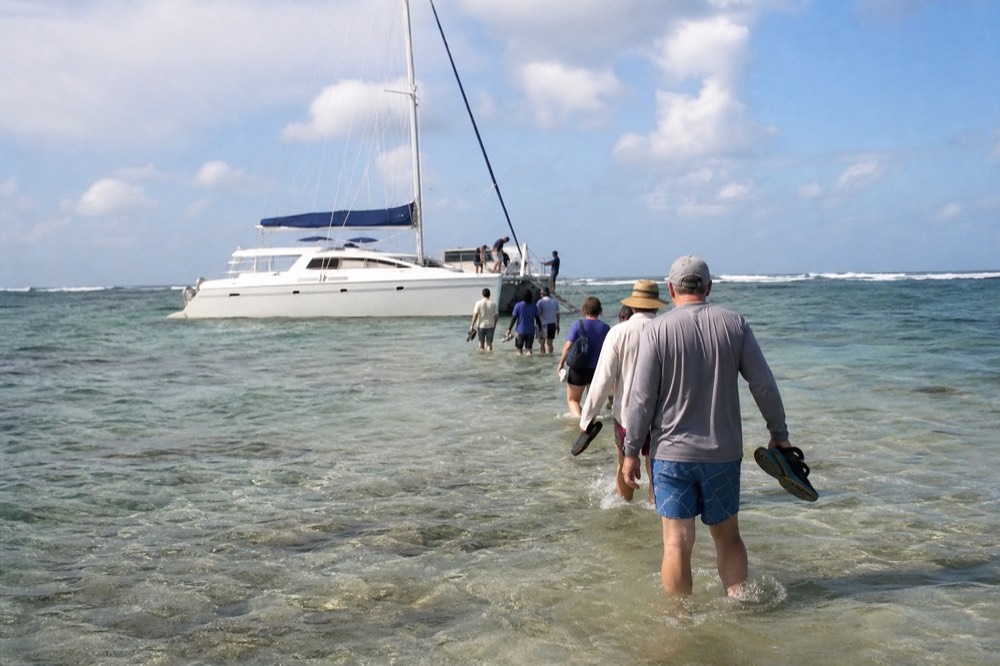
Tania, who sailed from Kaanapali in August 2026, described it plainly: "Food was excellent and the drinks kept coming. Getting on and off the boat was a thrill too."
The practical version: wear sandals you can carry, do not bring anything that cannot get splashed, and expect the return to be the same operation in the dark. Anyone using a stick, a wheelchair or a replacement joint should book a harbor boat rather than a beach load. Boats that load off the sand and the slip-loading harbor boats are two genuinely different products before the boat has even moved, and the Lahaina Harbor departures sit in the second group.
Where does the boat take you?
Every evening boat on Maui runs the same broad geography: out past the shore break or the breakwater, then up the sheltered lee coast into the Auau Channel between Maui and Lanai. Four islands surround that water, which is why it is normally the calmest cruising ground in Hawaii. Lanai sits directly ahead as the sun goes down.
Boats do not go far. This is not a passage, it is a slow arc into open enough water that nothing sits between the deck and the horizon, then a hold, then a return. Total distance offshore is measured in a couple of miles.
| Leg | Roughly when | What is around you |
|---|---|---|
| Clearing out | First 10 to 15 min | Breakwater or shore break; the West Maui ridgeline standing up behind you |
| Turning up the coast | 15 to 30 min | Land on one side, open channel on the other; wind usually easing |
| Out in the channel | 30 min to sunset | Lanai directly ahead, Molokai to the north, Kahoolawe to the south from Ma'alaea |
| Holding for the drop | The sunset itself | Boat turned side-on, engines down or sails eased, whole rail facing west |
| Running home | After dark | Shore lights coming up along the coast, mast light overhead |
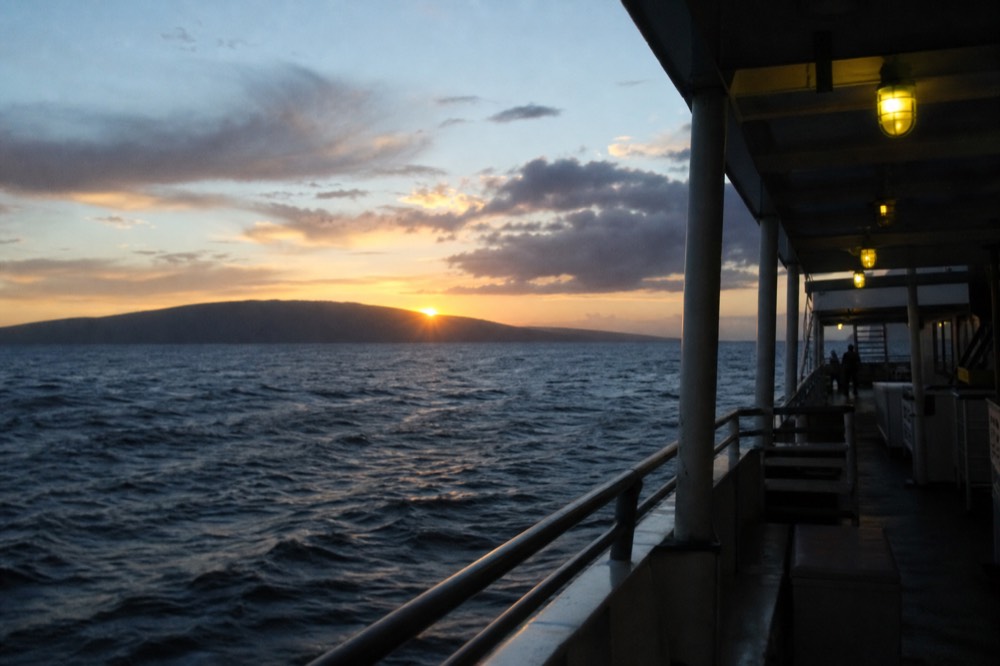
The direction of the drop changes through the year and it matters more than people realise. In winter the sun sets behind Lanai and the island turns into a flat black cutout with a lit sky above it, which is the shot everyone has seen. In midsummer the sun tracks further north and drops into the open gap between Lanai and Molokai, so you get the full uninterrupted fall into water. Neither is better. They are different photographs, and the month decides which one you get.
Trade winds normally run northeast at 10 to 20 knots or more, and the coast you are sailing along is the sheltered side of a mountain range. That combination is why the water settles once you are up the coast, even on an afternoon that felt breezy at the dock. Anyone worried about motion should read the marine forecast the day before, and the honest odds are covered in seasickness on the Auau Channel.
When do the drinks and the food arrive?
The bar opens once the boat is clear of the shore break or the harbor mouth, usually within the first fifteen minutes. Food follows on the outbound leg. Dinner boats start service well before the light goes, so that nobody is queueing or carving during the drop. Only the four and five-course boats spread service across the whole sailing.
Service timing is the difference between watching the sunset and eating during it. Every operator knows this and builds around it, but on a buffet boat the responsibility is partly yours.
| Boat type | Bar | Food | How the timing runs |
|---|---|---|---|
| Cocktail sail, open bar | Opens once clear, stays open | Passed appetizers | Drinks first, trays circulate on the outbound leg |
| Sail with appetizers | Drinks poured throughout | Trays and platters | Continuous, no seating call, no queue |
| Served dinner | Cocktails through the evening | Plated or served courses | Starts on the outbound leg, finished before the drop |
| Buffet with entertainment | Open bar on several boats | Full buffet line | Line opens before the light goes; join it early, not at golden hour |
| Carved dinner | Sold aboard on some boats | Prime rib or island fish, carved | Mid-cruise, well ahead of sunset |
| Four or five plated courses | Included | Paced courses | Spread across the full 2.5 hours, sunset falls between courses |
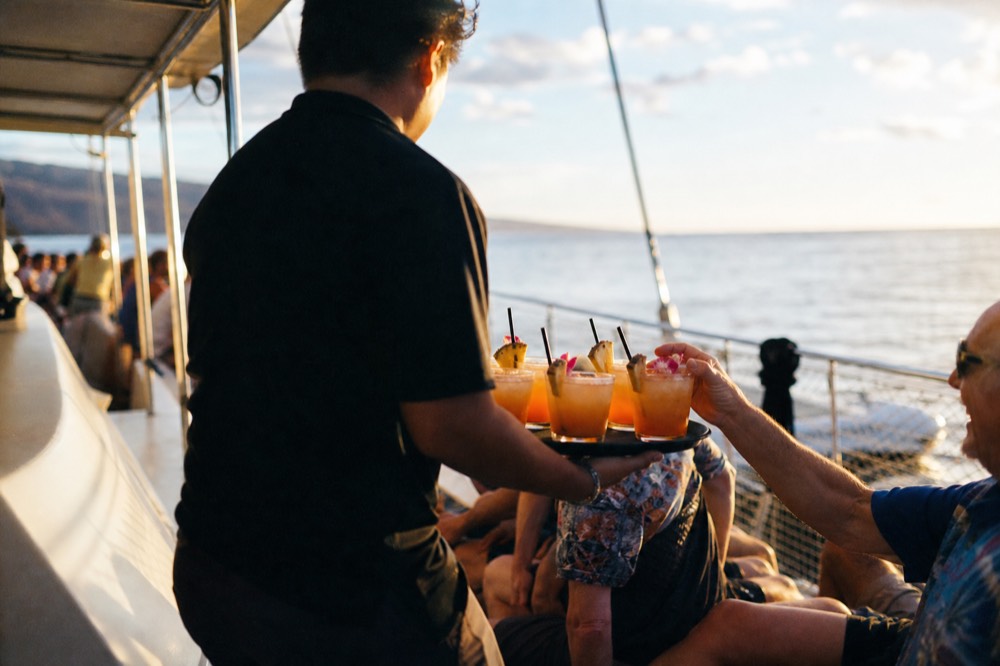
The buffet trap is real and easy to avoid. On the big Ma'alaea dinner boats the line opens early and there is a stretch, usually twenty minutes before the drop, where the deck empties and the queue is short. Go then. The people who complain about missing the sunset on a dinner cruise are, almost without exception, the ones who joined the buffet line at exactly the wrong moment. Reviewers on the carved-dinner boats consistently mention the opposite experience: a plate that arrives, then an hour of deck time.
What is the sunset like from the deck?
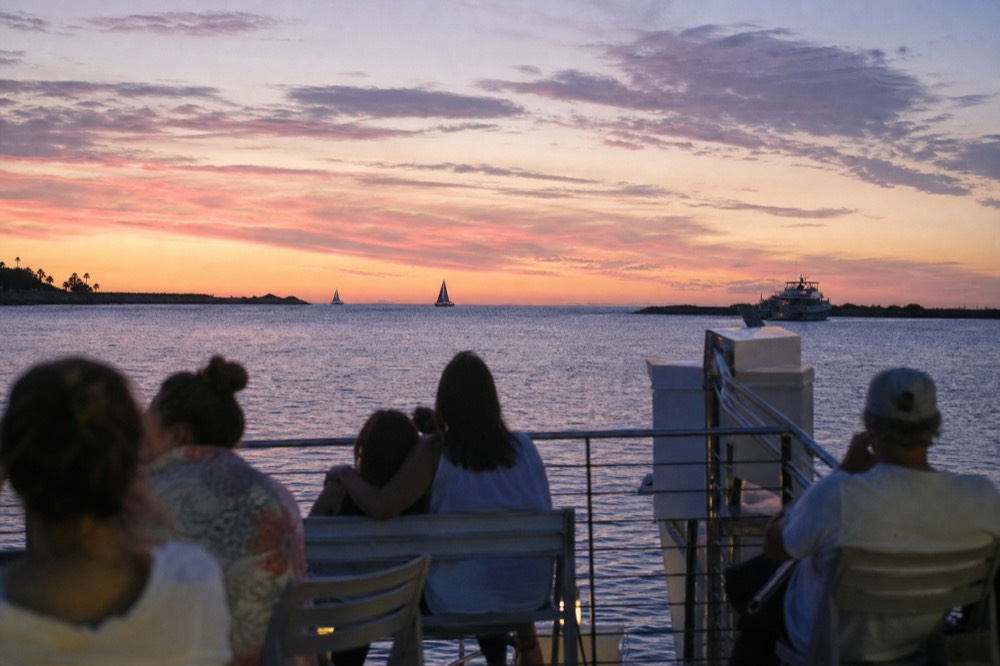
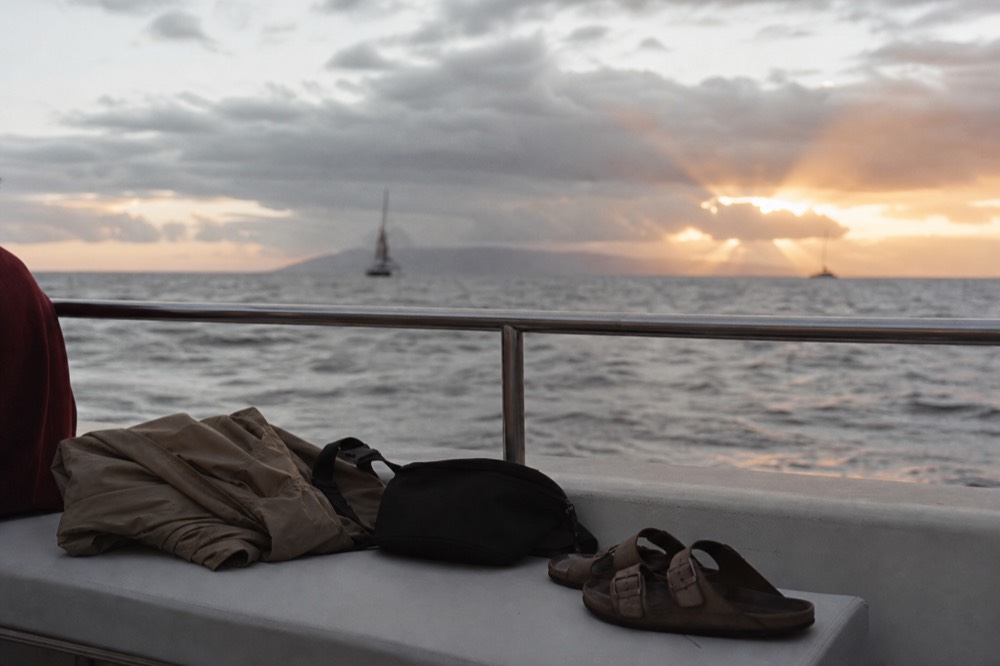
Better than from shore for two structural reasons: nothing is between you and the horizon in any direction, and you are on the water for the whole window rather than the ten minutes people usually catch. Crews turn the boat side-on and cut the engines, so the entire rail becomes the good seat rather than one corner of it.
The moment itself is quieter than expected. Engines drop, conversation drops with them, and for about four minutes the boat is mostly silent apart from water on the hull. Then the sun goes, someone claps, and the crew start moving again.
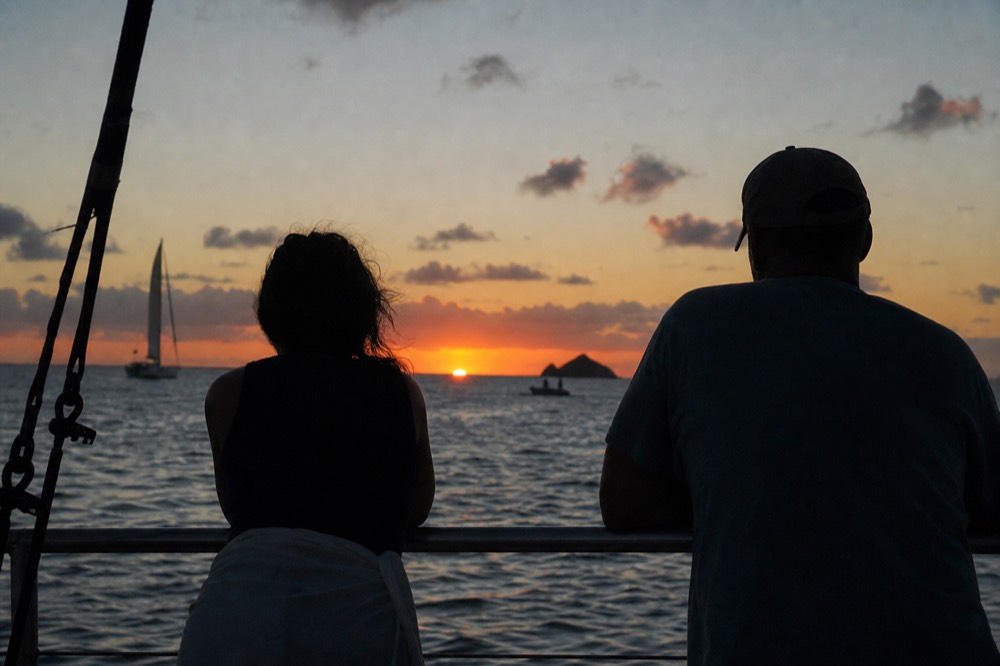
Stay out for the afterglow. The twenty minutes after the sun is gone are the part that people who have done this several times will tell you is the real event, when the whole western sky goes through colours the sun itself never showed. On a boat you are still out there for it. On a beach most people have already picked up their towels. Exact times for any date come from the US Naval Observatory sun tables, and the clock swings 88 minutes across the year, from 5:44pm in late November to 7:12pm in early July.
How cold, windy and wet does it get?
Windier and cooler than the beach you walked off, at every time of year. Trade winds normally blow northeast at 10 to 20 knots or more, and a moving deck adds to that. Spray on the outbound leg is common on sailing catamarans and rare on the big dinner hulls. The return, in the dark, is always the coldest part of the night.
Nobody is going to be cold in the Hawaiian sense of the word. But the difference between a still resort beach and a deck making six knots into a trade wind after sunset is enough that people who brought nothing regret it, every single evening, on every single boat.
| Months | Sunset on the 15th | Wind pattern | What the return feels like | Bring |
|---|---|---|---|---|
| December to February | 5:48pm to 6:25pm | Trades steady; Ma'alaea breeziest through the afternoon | Coolest returns of the year, in full dark | A real layer, not a shawl |
| March to May | 6:36pm to 6:57pm | Trades reliable, usually easing toward sunset | Mild; one light layer covers it | Light jacket, sunglasses |
| June to August | 6:56pm to 7:11pm | Trades often strongest in the afternoon | Warmest returns; many people never layer up | Sunglasses first, layer optional |
| September to November | 5:46pm to 6:29pm | Trades softening into autumn | Early departures, noticeably cooler returns | Light layer, closed bag |
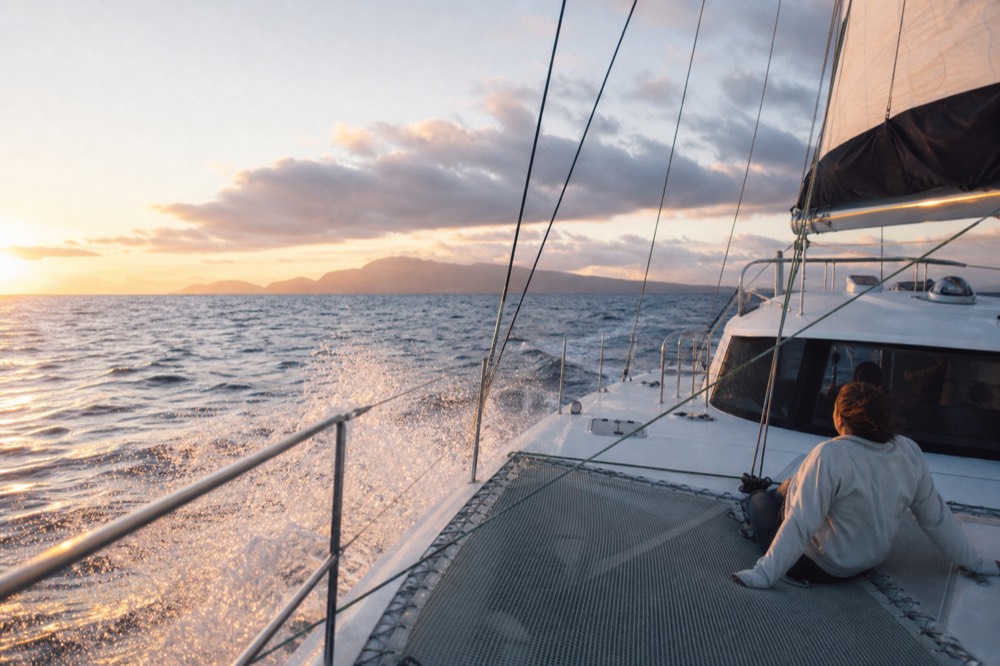
Spray depends far more on the boat than on the month. A sailing catamaran that actually heels will throw water over the windward bow on the outbound leg, which is why the trampoline netting between the hulls is both the best seat and the wettest one. A triple-deck dinner boat sits high and dry, and the upper deck stays dry in most conditions. Hair, phones and anything paper should be treated accordingly. The full kit list is in what to wear on the water after dark.
What happens on the way back in the dark?
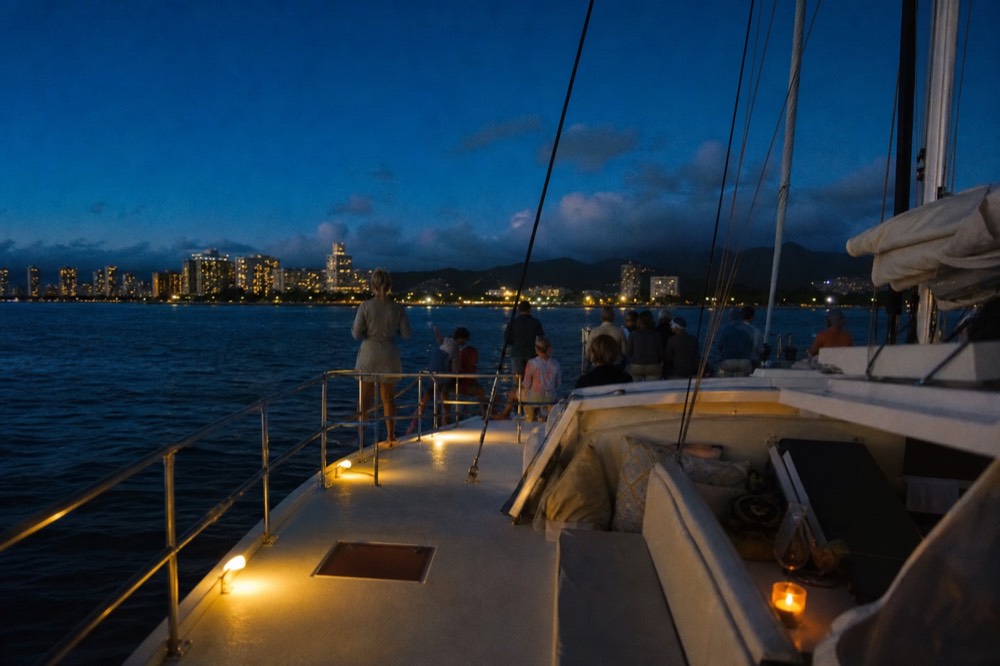
The last twenty to thirty minutes are a run home under running lights. On dinner boats dessert and coffee usually land here. On sailing boats the rig comes down and the engines go on. Kaanapali boats repeat the beach landing in the dark, which is genuinely the most memorable part of the operation for most first-timers.
Something shifts on the return leg. The light show is over, everyone has a drink, and the boat gets noticeably more social than it was on the way out. Crews tend to work the deck here, taking photographs and answering the questions people were too busy to ask earlier.
The beach landing after dark deserves its own warning, in the good sense. The catamaran turns, lines up on a stretch of sand marked by nothing much, and runs itself gently aground while crew drop into black water with torches to steady the step. Nobody who has done it forgets it. If that sounds like the wrong end of an evening, the harbor boats simply come alongside a lit dock and you walk off.
What are the unwritten rules on board?
Gratuity of 15 to 20 percent, not included in most fares, handed over on the way off. Drinking age is 21 and ID is checked aboard. Shoes off on most decks. Rail spots are first-come on drinks-only boats and assigned on dinner boats. Crew will cut off anyone who is over-served, because the operator's licence depends on it.
None of this is policed unpleasantly. Boat crews on Maui are, by the review record, remarkably good at making rules feel like hospitality. But knowing them in advance removes the awkward moments.
| Situation | What is expected |
|---|---|
| Gratuity | 15 to 20 percent of the fare, not in the price on most listings; given at the gangway or bow step |
| Alcohol | 21 and over, ID checked on board; operators run under boating-under-the-influence rules and will stop serving |
| Footwear | Off for beach loads and on most decks; carry sandals rather than wearing hard soles |
| Seating | Drinks-only boats are first-come at the rail; dinner boats seat you and expect you at your table for service |
| Photography | Fine everywhere; on several dinner boats a crew photographer circulates through the evening |
| Children | Welcome on most boats; the drinking-age rule applies to the bar, not the deck |
| Cancelling | Free on every boat here, 24 hours ahead on most and 48 on the Teralani sailings |
Tipping is the one people get wrong most often. The crew are working the rig, the galley and the bar inside the same two hours, and on most listings the fare does not include them. Bring some cash so the gesture does not depend on what the boat can process, and decide the number before you board rather than in the dark at the gangway.
What do first-timers wish they had known?
Four things, over and over: arrive earlier than feels necessary, wear something you can wade in, bring a layer for the return, and eat light beforehand because dinner service starts sooner than expected. The fifth, less often said: stay on deck after the sun is down, because the afterglow is the better half.
The most expensive mistake on this list is the first one. Check-in closes before departure, the boat leaves on time because it is chasing a sun that does not wait, and a missed sailing outside the cancellation window is simply gone.
| Mistake | What happens | Fix |
|---|---|---|
| Arriving at the departure time | Check-in has closed; the boat goes without you | Be at the kiosk or slip 45 minutes early |
| Shoes you cannot carry | Beach loads mean wading in knee-deep water | Sandals, or bare feet and a bag |
| No layer at all | Wind on a moving deck after dark, every month of the year | One light jacket per person, in a closed bag |
| A big late lunch | Dinner service starts roughly an hour in | Eat light, or book a drinks-only sail and eat ashore |
| Booking a beach load for someone with mobility limits | No dock, no gangway, no alternative once you are there | Book a harbor departure from Ma'alaea or Lahaina |
| No cash aboard | The tip becomes awkward at the gangway | Decide the number in advance and carry it |
| Leaving the rail when the sun goes | You miss the twenty best minutes | Stay out; the sky is not finished |
If you are still choosing the boat rather than preparing for one, the decision is mostly about whether dinner happens on the water or ashore. Dinner service on the water is a different evening from a two-hour sail with an open bar, and which boat suits which evening sorts all twenty by rating, review base and fare, with every boat on the island in one table on the front page.
Your evening, your choice
Choose your Maui evening
Initial editorial pick — use the optional filters to narrow it.
Compare options, fit and total cost
Why consider another option?
- Calypso sunset dinner cruise — Table-side dinner and two included alcoholic drinks on a two-hour harbor cruise. Maalaea · 2 hours · English. Additional drinks cost extra. Infants 0–3 have no included meal. Confirm any access requirements with the operator.
- Teralani sunset cocktail sail — Chef-inspired appetizers and an open bar on a two-hour catamaran sail. Kaanapali · 2 hours · English. Wade through the water and remove shoes to board. Not suitable for wheelchair users. Alcohol 21+; bring photo ID. Cancellation cutoff is two days ahead.
- Alihilani sunset sail — Two and a half hours of sailing with appetizers, beer, wine and cocktails. Lahaina · 2.5 hours · English. Check in 30 minutes early at 116 Prison Street; follow your ticket for current harbor instructions.
- Sea Maui sunset dinner sail — Chef Jai buffet dinner and a full open bar over two and a half hours. Kaanapali · 2.5 hours · English. Beach boarding is not recommended for mobility difficulties. Check in 30 minutes early; alcohol 21+.
- Maalaea six-guest powerboat cruise — A two-hour powerboat outing capped at six guests, with light snacks and nonalcoholic drinks. Maalaea · 2 hours · English. Shared, per-person tickets. Six seats do not establish a private-charter contract. Not wheelchair accessible.
Compare the whole evening
Use current, same-currency totals for your group, including tax, food, drinks, parking and any planned tip.
A shared ticket total is not an exclusive-charter quote. Compare inclusions as well as the difference.