What to Wear on a Sunset Cruise in Maui
Mainland dinner boats turn people away at the gangway for wearing jeans. Nothing on this island does. What Maui takes seriously instead is the thing nobody packs: a layer for the twenty minutes after the sun goes.
Short answer
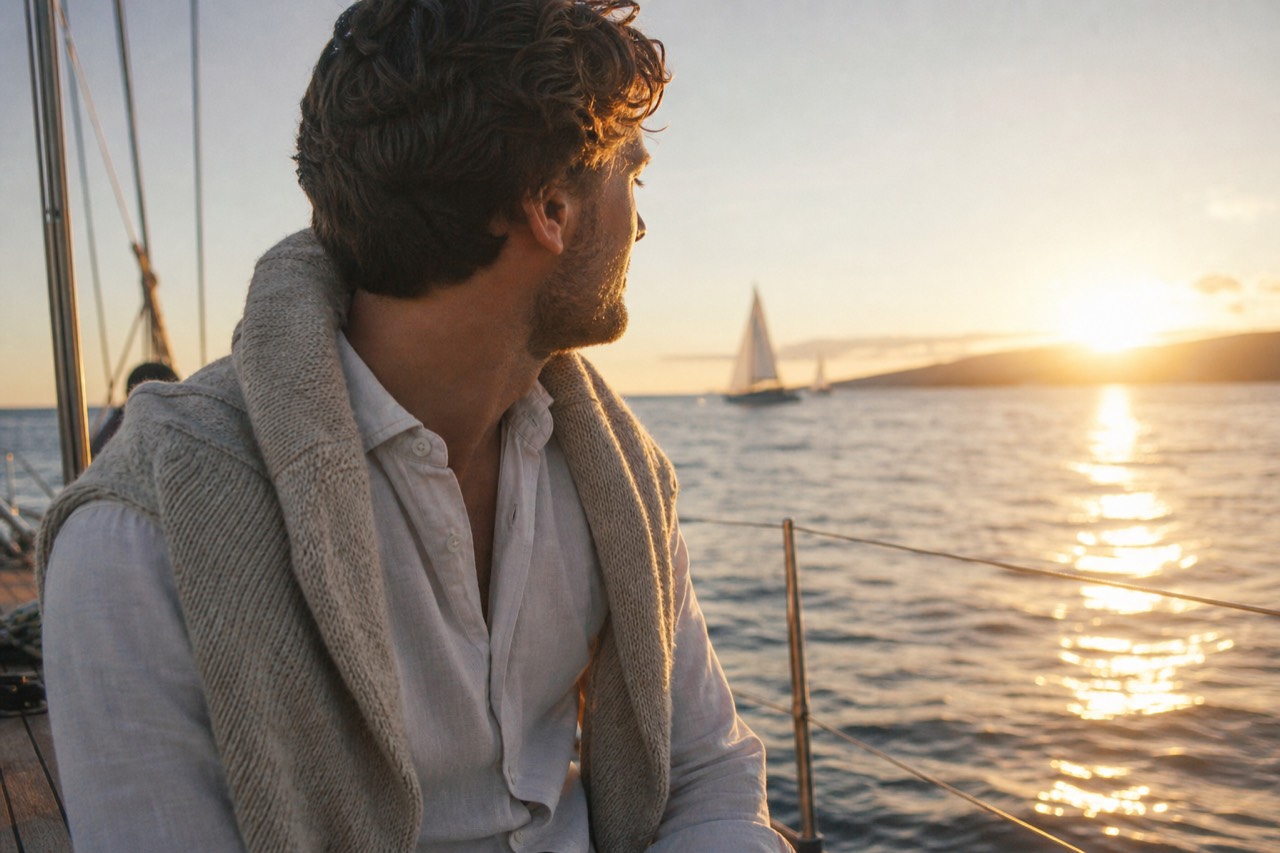
Resort casual works on every boat on this island, and not one of the twenty sunset listings enforces a dress code. The single non-negotiable is a warm layer, because apparent temperature underway runs 10 to 15 degrees below the same evening ashore. Flat shoes beat heels on any deck, and Kaanapali departures mean wading in.
Somebody packs a jacket for a Maui evening and feels faintly ridiculous doing it. Eighty-four degrees at four in the afternoon, trade winds, sand still hot underfoot. Then the boat turns for home at seven with the sun gone, twelve knots of apparent wind coming over the bow, damp swimwear under a cotton shirt, and that jacket becomes the best decision of the trip. The people who left theirs in the room spend the last half hour with their arms folded.
That is the whole of Maui dress advice compressed into one paragraph, and it is almost the opposite of what visitors expect. There is no gangway to be judged at. There is no jeans rule, no jacket requirement, nothing to get wrong socially. What there is instead is a physics problem that sneaks up on people around forty minutes into a two-hour sailing.
Is there a dress code on a sunset sailing in Maui?
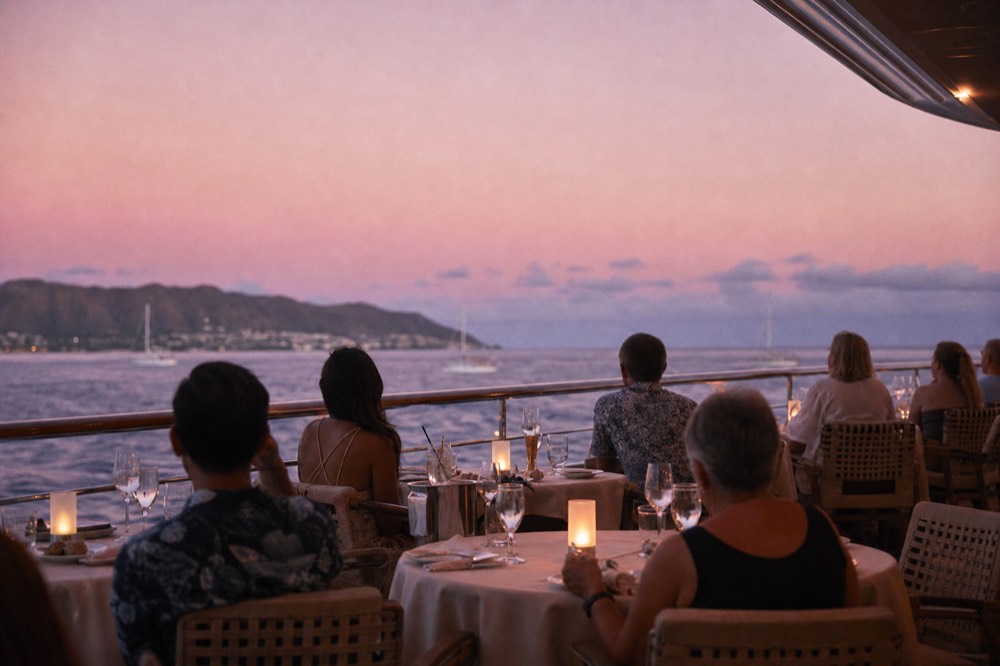
No. Not one of the twenty sunset boats operating here publishes or enforces a dress code, including the plated dinner sailings at the top of the price range. Resort casual is the working standard everywhere: a sundress, shorts and a shirt, linen, whatever you wore to lunch, plus something warm for later.
This is a genuine difference between Maui and the harbor-dinner-cruise products people may have done elsewhere. Mainland dinner boats in New York, Chicago and San Francisco often publish semi-formal requirements and name specific banned garments. Nothing here does. The most expensive sailing on this island, a five-course dinner on a 65-foot catamaran out of Maalaea at $290, has the same expectation as the $59.95 cocktail cruise leaving from the same harbor: turn up comfortable.
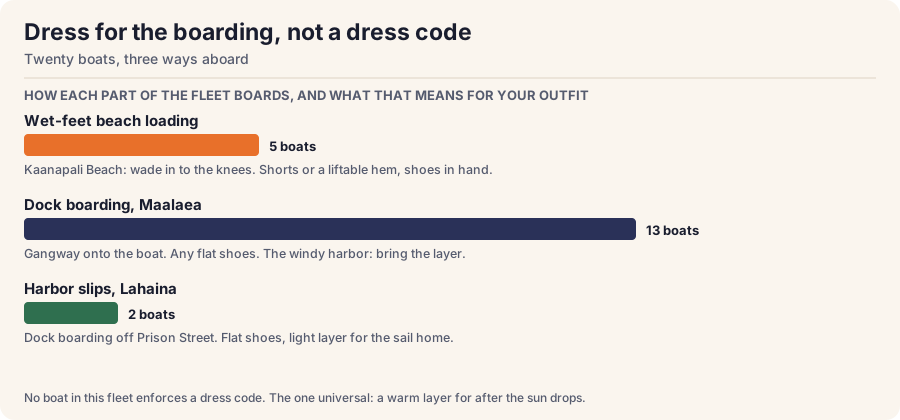
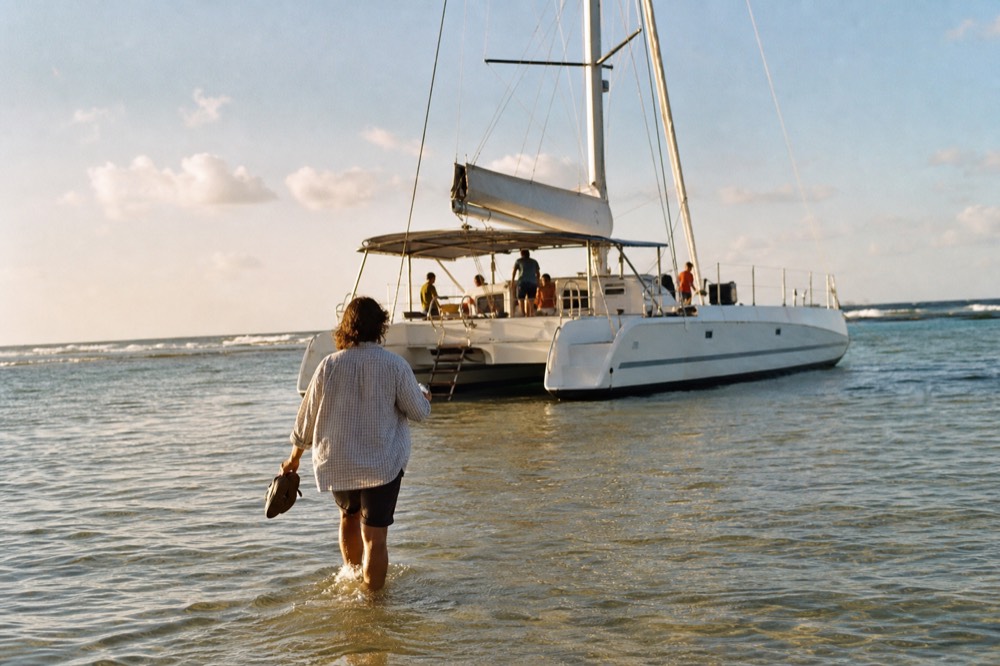
There is a reason for that beyond island temperament. Three of the five departure points load off a beach, which means guests walk into the water to board. It is not possible to enforce formal dress on a product where the boarding procedure soaks your hem. The operators built the standard around the logistics rather than the other way round.
What replaces a dress code is a set of practical constraints, and they are more demanding than a dress code would be. Wind on a moving deck. Salt spray. A wet boarding at three of five departure points. Deck surfaces that punish narrow heels. Sun for the first hour that is stronger than it feels. Get those right and nobody will ever comment on what you are wearing.
What is the one thing almost everyone forgets?
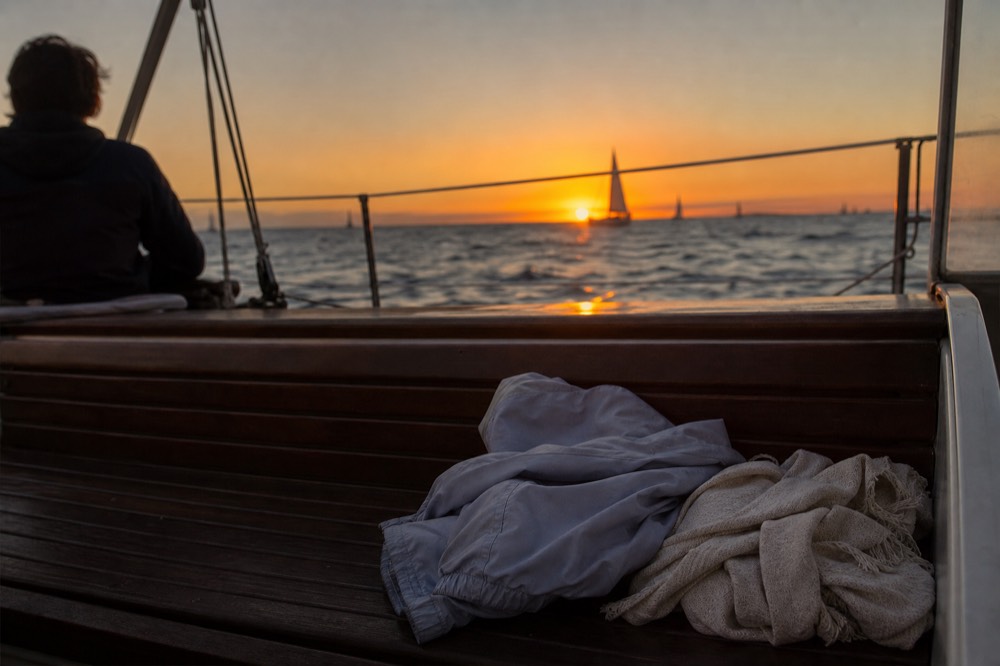
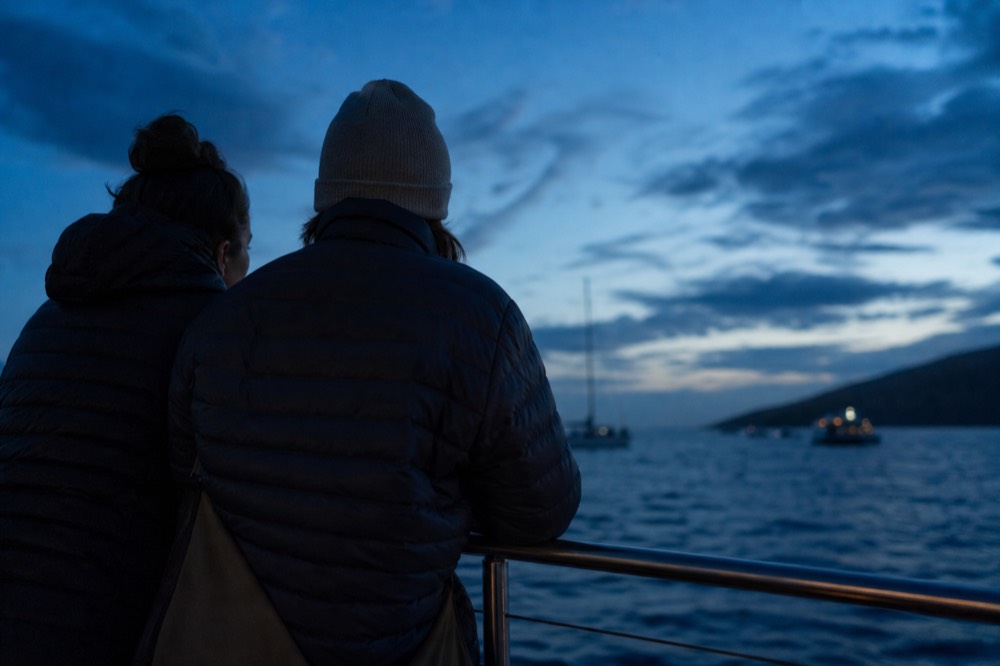
A warm layer. Apparent temperature on a moving boat after sunset typically runs 10 to 15 degrees Fahrenheit below what the same evening feels like standing on the beach, because the trades arrive unbroken over open water and the vessel adds its own wind on top of them. Bring the layer in every month.
The mechanism is worth understanding because it explains why the mistake is so consistent. Ashore, buildings, palms and terrain break the wind, and the sand holds heat well into the evening. Out on the channel there is nothing to break anything, the northeast trades are running at ten to twenty knots or more, and a catamaran doing seven knots into that wind is generating a headwind that adds to it. Then the sun goes, radiant heating stops, and any damp fabric on your skin starts to evaporate.
Damp is the accelerant nobody accounts for. People come off a beach loading with wet legs, or they were swimming an hour earlier, or a bow wave sent spray back over the deck. Wet cotton against skin in fifteen knots of wind is how a warm night turns cold in ten minutes, and it happens in August as readily as in January.
The layer does not need to be much. A light sweatshirt, a packable windbreaker, a pashmina or a long-sleeve linen shirt covers it in the summer months. December through February the honest answer is slightly more: a proper fleece or a light jacket, particularly on the 2.5-hour and 3-hour sailings where you are out later. Nobody has ever regretted carrying one, and it packs into nothing.
What should you wear on each type of boat?
Broadly the same thing, with three adjustments. Dinner sailings lean a notch smarter because there is a table involved. Performance sails see the most spray, so quick-dry beats cotton. Beach-loading departures need a hem you can lift and shoes you can carry. Everything else is identical across the fleet.
| Boat type | What people actually wear | Adjust for | Skip |
|---|---|---|---|
| Plated dinner sail, 2.5h | Sundress, linen shirt and chinos, resort casual | A real layer, you are out latest | Heels, anything dry-clean only |
| Buffet dinner and show, 2h | Shorts and a shirt, casual dress | Upper decks are windier than the main | Wide floppy hats on the top deck |
| Cocktail sail with open bar, 2h | Swimwear under a cover-up, shorts, tank | Wet feet if loading off Kaanapali | White that turns transparent when damp |
| Performance sail, 2 to 2.5h | Quick-dry shorts, technical top, cap with a cord | Spray over the bow, trampoline seating | Cotton, loose hats, long flowing hems |
| Luxury sail with open bar, 2h | Smart casual, a nice cover-up | Still a boat, still flat shoes | Anything that reads as formalwear |
| Shared powerboat, max six | Windproof layer, sunglasses on a cord | Highest apparent wind of anything in the fleet | Loose anything, it will leave |
The dinner sailings are where people overthink it most, because a served three, four or five-course dinner sounds like it demands something. It does not. The 2.5-hour served dinner sail off Kaanapali at 4.8 across 149 reviews boards by wading out to the boat from the sand, which settles the question of formality on its own.
The one genuine wardrobe distinction is between an open trampoline catamaran and a covered dinner deck. On a trampoline you will get some water, you will be sitting on netting, and quick-dry fabric is simply more pleasant. On a covered dinner deck you might not get touched by spray at all. Both still need the layer.
How much colder does it actually get out there, month by month?
Enough to matter every month, and enough to end the evening early in December and January. Air temperature barely moves across a Maui year, but apparent temperature underway does, because wind speed and how wet you are do the work. Summer needs a long sleeve. Winter needs a fleece.
Maui's air temperature is famously stable: the difference between the warmest and coolest month is a handful of degrees. What changes is the sunset time, how long you are out after dark, and whether the trades are running hard. December has you back at the dock by 6:25pm in the last of the light. July has you out until nearly eight, in the strongest trade winds of the year.
| Month | Sunset | Time on deck after dark | Layer that works | Also pack |
|---|---|---|---|---|
| January | 6:07 pm | 30 to 40 min | Fleece or light jacket | Long sleeve under it, whale season means rail time |
| February | 6:25 pm | 30 to 40 min | Fleece or light jacket | Wrap for the shoulders |
| March | 6:36 pm | 25 to 35 min | Light jacket or heavy knit | Cap with a cord, trades picking up |
| April | 6:46 pm | 25 to 35 min | Sweatshirt or knit | Sunglasses, the first hour is bright |
| May | 6:57 pm | 20 to 30 min | Sweatshirt or windbreaker | Reef-safe sunscreen |
| June | 7:09 pm | 20 to 30 min | Long-sleeve shirt or light hoodie | Hair tie, trades are up |
| July | 7:11 pm | 20 to 30 min | Long-sleeve shirt or light hoodie | Windproof outer for Maalaea departures |
| August | 6:56 pm | 20 to 30 min | Long-sleeve shirt | Quick-dry over cotton |
| September | 6:29 pm | 25 to 35 min | Sweatshirt | Calmest month, least wind |
| October | 6:02 pm | 30 to 40 min | Sweatshirt or knit | Back at the dock early, dinner ashore |
| November | 5:46 pm | 35 to 45 min | Light jacket | Earliest sunsets of the year |
| December | 5:48 pm | 35 to 45 min | Fleece or light jacket | Warmest thing you brought to Hawaii |
Harbor matters as much as month. Maalaea sits on the isthmus where the trades funnel between the two mountain masses, which makes it one of the breeziest harbors in the state through the afternoon, though it usually eases toward the drop. Kaanapali and Lahaina sit in the lee of the West Maui Mountains and in the shelter of the Auau Channel, which four islands protect, so they are consistently the calmer, warmer option. Current conditions come from the NWS Hawaii coastal waters forecast, the harbors themselves are run under Hawaii's commercial boating rules, and the departure points are compared across the windiest harbor departures.
Winter adds one wrinkle that has nothing to do with temperature. From November through May, with peak abundance January to March, humpbacks are in the channel, and every vessel has to stay 100 yards clear of them under the federal rule described on NOAA's sanctuary boating page. Distance viewing means standing at the rail for longer stretches than a summer sailing asks of you, in the coolest months of the year. That is the single scenario where an underdressed guest ends up watching from inside.
What does beach loading at Kaanapali do to your outfit?
It soaks you to somewhere between the ankle and the knee. Five boats load off the sand at Kaanapali rather than from a dock: guests walk into the shallows, hand up their shoes and bags, and climb aboard from the water. Wear a hem you can lift, carry your footwear, and put anything electronic in a dry bag.
This is the single most surprising thing about a Maui evening on the water, and it delights as many people as it catches out. There is no gangway. The catamaran noses in toward the beach, the crew steps into the water, and boarding happens with everybody wet to mid-calf. One traveller described boarding as "a thrill". Somebody in a long dress and good sandals describes it differently.
The workable approach is simple: dress from the knees up. Whatever you want to wear for the evening is fine as long as the bottom of it can be lifted or does not care about salt water. Shoes come off before you reach the water and go back on once you are on deck and dry. A small dry bag or a zip pouch handles phones, keys and ID.
| Departure point | Boarding | What gets wet | Dress note |
|---|---|---|---|
| Kaanapali, Whalers Village kiosk | Wade out to the boat | Ankles to knees | Liftable hem, shoes in hand |
| Kaanapali, Aqualani kiosk by the Outrigger | Wade out to the boat | Ankles to knees | Same, plus a towel in the car |
| Kaanapali, Leilani's lawn | Short beach walk, then wade | Ankles to knees | Same, sand between lawn and water |
| Lahaina Harbor, 116 Prison Street | Dock and gangway | Nothing | Dry boarding, dress freely |
| Maalaea, slips 56, 72 and 76 | Dock and gangway | Nothing | Dry boarding, but windiest harbor |
| Maalaea north dock | Dock and gangway | Nothing | Dry boarding |
If a dry boarding matters, and for a proposal or an anniversary outfit it might, the harbor departures solve it entirely. Lahaina and Maalaea both put you on a dock and down a gangway with dry feet. The trade-off is a drive and a parking lot rather than a walk from the beach. All of the wet-feet options are laid out across the beach-loading departures at Kaanapali, and the practical kit list beyond clothing sits in what to bring aboard beyond clothes.
Which shoes actually work on a deck?
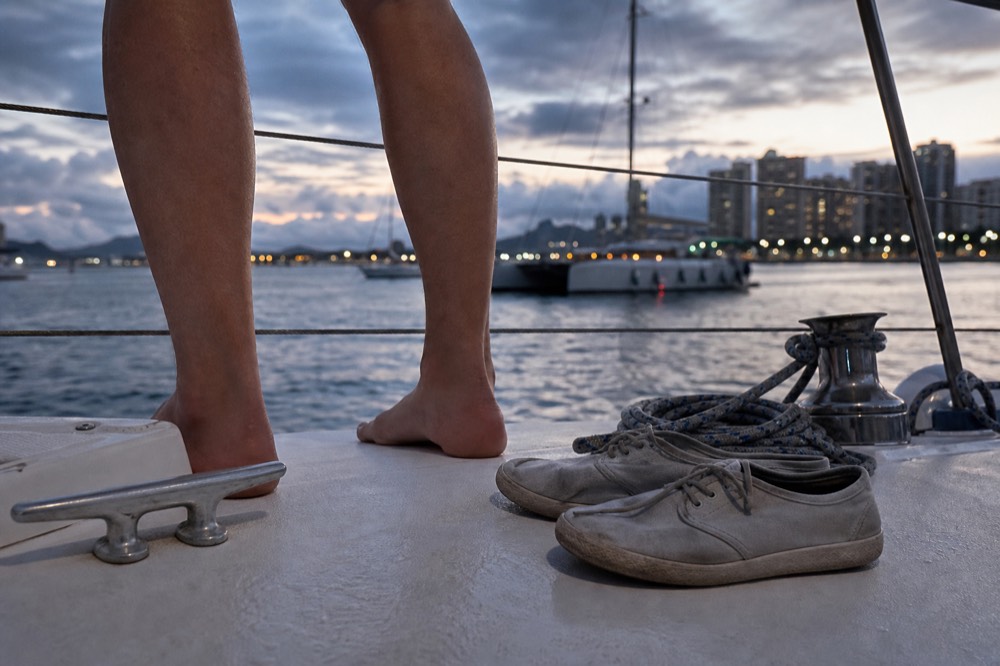
Flat, and ideally ones you can carry. Boat decks are wet, they move in three directions, and they are covered in cleats, seams, hatches and coiled line. Heels catch. Many crews prefer bare feet on a sailing catamaran anyway, and on trampoline netting a heel is genuinely unsafe.
Footwear is the one area where a real rule exists, even if nobody writes it down. A moving deck is not a floor. It pitches, it rolls when a swell crosses, and the surfaces that give grip when dry give none when wet. Add a narrow heel and you have the most common way people hurt themselves on a boat that is otherwise entirely safe.
| Footwear | On a sailing catamaran | On a big dinner deck | Verdict |
|---|---|---|---|
| Bare feet | Preferred by most crews | Fine on the main deck | Best on any sail boat |
| Flip flops or slides | Fine, easy to carry through the water | Fine | The default here, and correct |
| Boat shoes or flat sneakers | Good grip, but wet from the beach load | Very good | Best if you want covered feet |
| Flat sandals with a back strap | Good | Good | The safe dressy option |
| Block heel | Awkward, avoid on trampolines | Manageable, walk carefully | Only on the covered dinner decks |
| Stiletto or narrow heel | Unsafe | Unsafe | Leave it in the room |
| Anything leather you love | Salt spray will find it | Possible but risky | Not worth the risk |
The beach loadings settle the argument before it starts. If you are wading out to the boat, whatever is on your feet has to come off anyway, so the practical choice is something that slips off in a second and does not mind sitting in a bag. A pair of flat sandals covers the whole evening: carried through the water, back on for dinner, off again if you want the trampoline.
What should stay in the hotel room?
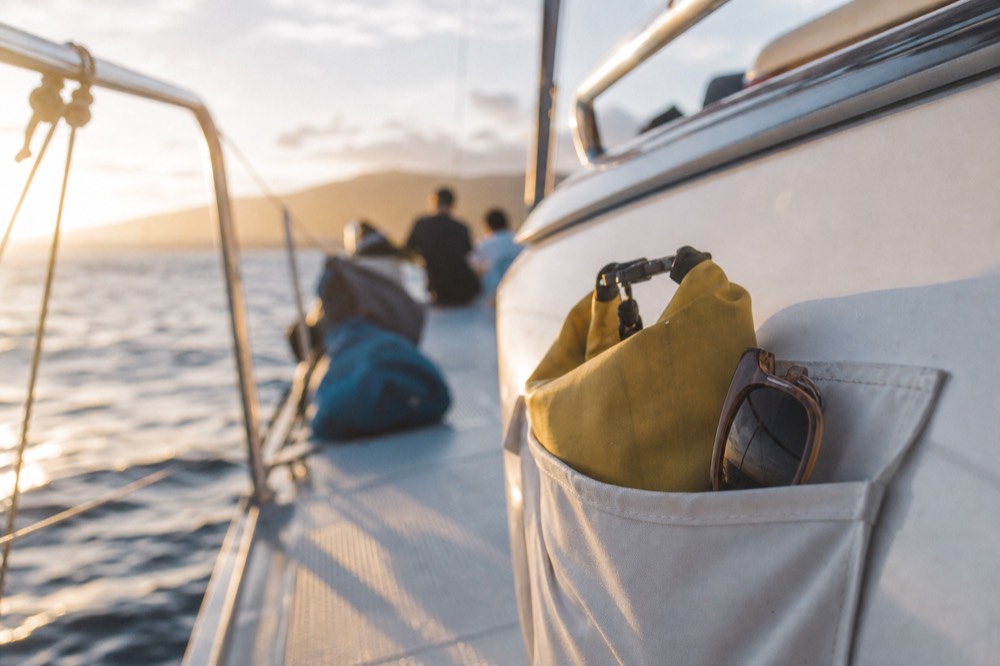
Wide floppy hats without a chin cord, sunglasses you care about, big beach bags, anything you would be upset to lose over the side, and heels. Deck space is finite, the wind is constant, and there is no lost property department on the channel.
Wind is the deciding factor for most of this list. A wide-brim sun hat that behaved perfectly on the beach becomes a kite the moment the boat is making way. Crews watch hats leave every week. A cord or a chin strap fixes it entirely, and a baseball cap worn backwards under way is the unglamorous solution that works.
Bags are the second issue. On a catamaran carrying forty to a hundred guests, there is nowhere to put a large beach bag except at your feet, where it will be kicked and will collect spray. A traveller who sailed the premium dinner out of Kaanapali in May 2026 put the whole question to bed in one line. "No need for towels or a bag just take a camera," wrote Karen. That is not quite universal advice, since ID and a layer both have to come from somewhere, but the direction is right.
| Leave behind | Why | Bring instead |
|---|---|---|
| Wide floppy sun hat | Departs on the first gust | Cap with a cord, or nothing |
| Expensive sunglasses | The most commonly lost item on any boat | Cheap pair, ideally on a retainer |
| Large beach bag | Nowhere to put it, collects spray | Small zip pouch or dry bag |
| Towels | Nobody swims on a sunset sailing | Nothing, the wading is shallow |
| Heels | Unsafe on a moving deck | Flat sandals |
| Heavy jewellery | Salt, wind and a rail | Leave it, genuinely |
| Beach umbrella or chairs | Not permitted, not needed | Nothing |
| Anything white and thin | Turns transparent once damp | Colour, or a heavier weave |
Two things do have to come with you and often get forgotten. Photo ID, because the drinking age here is 21 and it is checked aboard, which matters on the five boats running open bars. And a phone that is protected, because the most common way a phone dies on a sunset sailing is not a dramatic drop over the side but slow salt spray on an open deck. What actually happens over the course of an evening is covered in how an evening on the water unfolds.
Does what you wear change your photographs?
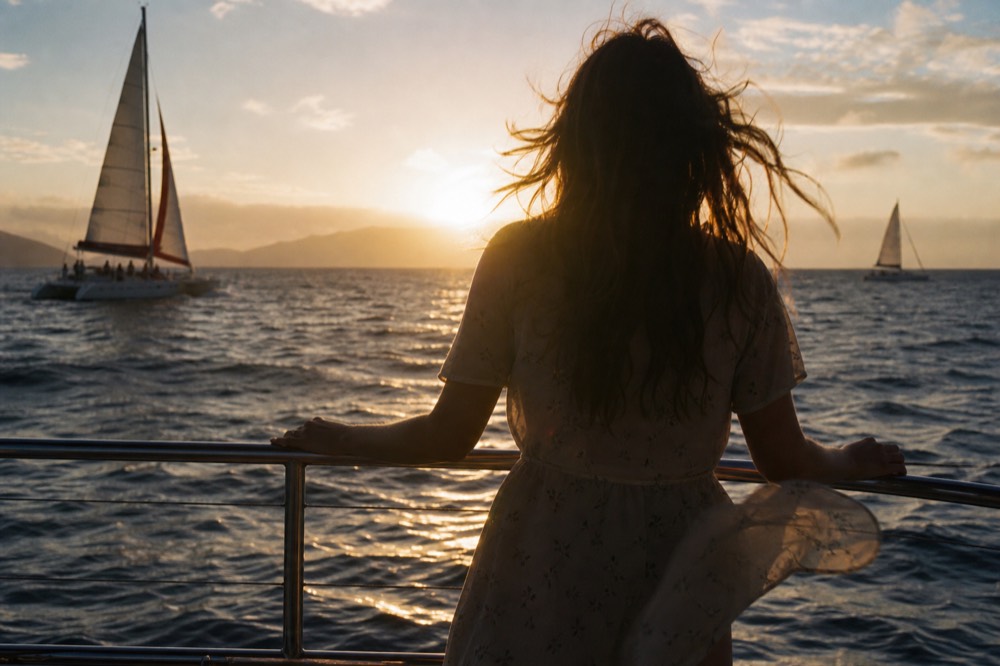
Considerably, because you are being shot into a light source. Pure white blows out against a bright sky and pure black collapses into silhouette. Mid-tone warm colours hold detail. Loose fabric moves in the trade wind, which reads well in a photograph and badly in a video.
Backlighting is the whole problem. At sunset the brightest thing in the frame is behind you, so a camera exposing for the sky turns anything in front of it dark, and a camera exposing for faces blows out the sunset. Wearing something in the middle of the tonal range gives the sensor a chance at both. Warm tones, coral, rust, gold, sand, catch the low light directly and glow rather than going grey.
| Choice | Against a sunset | Better option |
|---|---|---|
| Pure white | Blows out, loses all texture | Cream, sand, pale warm neutral |
| All black | Collapses to a flat silhouette | Navy, deep green, charcoal |
| Busy small print | Turns to noise at distance | Solid, or a large simple pattern |
| Neon or fluorescent | Fights the sky for attention | Muted warm tones |
| Stiff structured fabric | Sits dead in the wind | Linen, cotton voile, anything with drape |
| Loose long hair | Covers the face in every frame | Tie it, or stand with the wind behind |
| Matching outfits | Reads as staged | One colour family, different pieces |
| Hat with a wide brim | Shadows the entire face | Nothing, or push it back |
Several boats put a crew photographer on board, so this matters more than it would on a beach where you are shooting for yourselves. The practical version: stand where the wind is behind you rather than across you, wear something that moves, and put on the layer before the light goes rather than after, so the photographs and the warmth happen in the same twenty minutes.
What about children, and what about an occasion?
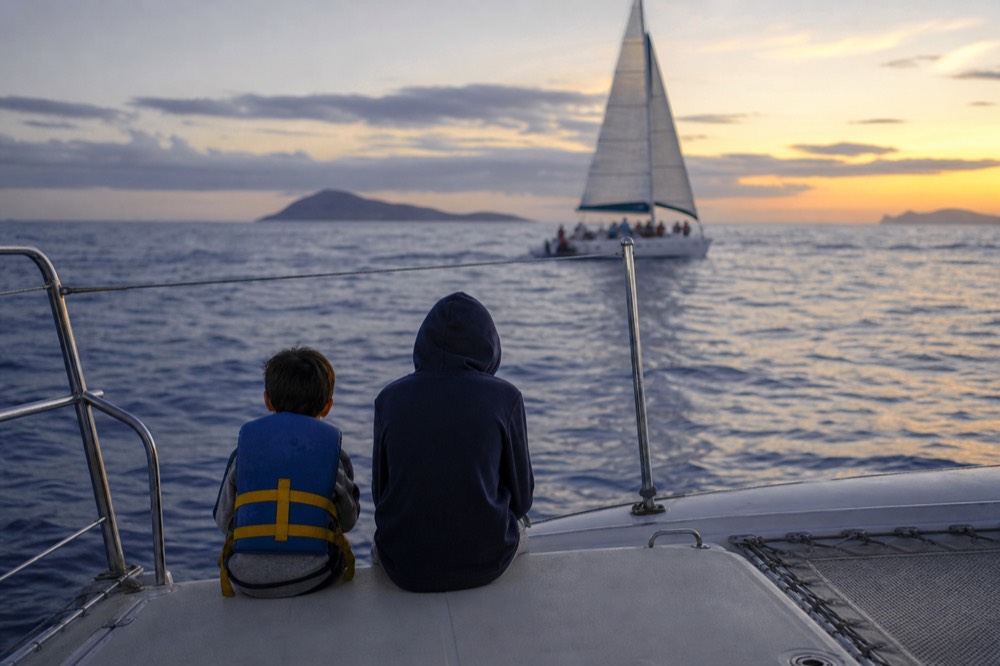
Kids need the same layer adults do plus a hooded top, because they get cold faster and they will be at the rail the whole time. For an anniversary or a proposal, dress up as much as you like, then choose a Lahaina or Maalaea dock departure so the outfit does not have to wade.
Children on these boats do fine, and the clothing question is straightforward: something they can move in, a hooded sweatshirt for the return, and shoes that come off easily for a beach loading. Damp swimwear under clothes is the thing to avoid, because a cold child on a boat has nowhere to go. A dry change of shorts weighs nothing.
Occasion dressing is where the departure point becomes a real decision rather than a detail. Nobody wants to wade into the Pacific in the outfit they chose for a proposal. Lahaina Harbor and Maalaea both board from a dock, dry, which removes the problem entirely. That is worth more than any dress code, and it is a factor almost nobody weighs when booking.
Everything anybody actually needs on one of these boats fits in a pouch the size of a paperback, which is the opposite of what most people carry down to the beach. The list below is the whole of it, and the reason to keep it short is that deck space is shared and nothing has a locker.
| In the pouch | Why | Skip it if |
|---|---|---|
| A packable layer | The one item nobody regrets, in every month | Never skip it |
| Photo ID | Drinking age is 21 and it is checked aboard | Nobody in the party is drinking |
| Phone in a zip bag | Salt spray kills more phones here than drops do | You are leaving it in the car |
| Reef-safe sunscreen | The first hour is brighter than it feels | Departure is after 6pm in winter |
| Sunglasses on a retainer | Glare off water is the whole first hour | Sunset is already down at boarding |
| Hair tie | Trades run 10 to 20 knots plus | Short hair |
| Motion sickness tablet | Taken an hour ahead, not on board | You know you are fine on boats |
| Small cash for the crew | Tipping is normal and cards are awkward at sea | You have already tipped online |
That list changes slightly depending on which end of the fleet you book. On the cocktail sails with an open bar, ID moves to the top and a cover-up matters more than anything smart. On boats that serve a full dinner, the layer matters most, because those are the 2.5-hour sailings that keep you out latest.
Sun is the other half of an occasion evening, and it is the half people forget because the light looks gentle. The first hour of a sailing that departs at five in June is under a sun still high enough to burn, reflected off water in every direction. Hawaii law bars the sale of sunscreens containing oxybenzone and octinoxate, so a reef-safe mineral formula is what you will find on the island anyway. Put it on before boarding rather than on a moving deck.
Common questions about dressing for the water
In short: no dress code on any boat here, a layer in every month, flat shoes always, wet feet at three of the five departure points, and photo ID if you plan to use the open bar. Everything else is preference.
Can you wear jeans on a Maui sunset sailing?
Yes, on any boat on this island. Nothing here bans them. In practice few people do, because denim is warm for a Hawaiian afternoon and slow to dry if it catches spray or a beach loading. Linen or light cotton is the more comfortable choice, not the more correct one.
Do you need to dress up for a dinner sailing?
No. The plated dinner sails carry the same expectation as the cocktail cruises: resort casual. Plenty of guests do dress up because a served dinner at sunset feels like an occasion, and that is entirely welcome. Nobody will be turned away for shorts.
Should you wear a swimsuit under your clothes?
Only on the cocktail sails if you want to, and there is no swim stop on a sunset departure anywhere in the fleet. What matters more is not sitting in damp swimwear for two hours after dark, which is a reliable way to be cold. Dry clothes over dry skin is the better call.
What do you do with your shoes during a beach boarding?
Carry them. Take them off on the sand, hold them above the water, and put them back on once you are aboard and your feet have dried. Crews are used to it and will take bags and shoes up for you as you climb.
Is it cold enough to need a jacket in summer?
A long-sleeve shirt or a light hoodie is enough from June through September, and it is still needed. Air temperature stays warm all year, but apparent temperature underway drops 10 to 15 degrees once the sun is down and the boat is making way into the trades.
Do the boats provide blankets?
Not as a rule, and it is not something to plan around. The layer you bring is the layer you have. On the 2.5-hour and 3-hour sailings in December and January this is worth taking seriously, because those are the evenings with the most time on deck after dark. Sunset times month by month sets out exactly how long that is, and the full fleet comparison by harbor shows which boats board wet and which board dry.
Your evening, your choice
Choose your Maui evening
Initial editorial pick — use the optional filters to narrow it.
Compare options, fit and total cost
Why consider another option?
- Sea Maui sunset dinner sail — Chef Jai buffet dinner and a full open bar over two and a half hours. Kaanapali · 2.5 hours · English. Beach boarding is not recommended for mobility difficulties. Check in 30 minutes early; alcohol 21+.
- Maalaea six-guest powerboat cruise — A two-hour powerboat outing capped at six guests, with light snacks and nonalcoholic drinks. Maalaea · 2 hours · English. Shared, per-person tickets. Six seats do not establish a private-charter contract. Not wheelchair accessible.
- Calypso sunset dinner cruise — Table-side dinner and two included alcoholic drinks on a two-hour harbor cruise. Maalaea · 2 hours · English. Additional drinks cost extra. Infants 0–3 have no included meal. Confirm any access requirements with the operator.
- Teralani sunset cocktail sail — Chef-inspired appetizers and an open bar on a two-hour catamaran sail. Kaanapali · 2 hours · English. Wade through the water and remove shoes to board. Not suitable for wheelchair users. Alcohol 21+; bring photo ID. Cancellation cutoff is two days ahead.
Compare the whole evening
Use current, same-currency totals for your group, including tax, food, drinks, parking and any planned tip.
A shared ticket total is not an exclusive-charter quote. Compare inclusions as well as the difference.